


























What are Wire Wheels, Their Types, and Uses?

Wire brushes are a superb choice for removing rust and oxidation, paint, slag, weld splatter, and other unwanted surface contaminants with angle grinders, bench grinders, or drills.
What is a Wire Wheel?
A wire brush can be any brush tool with metal bristles, most often steel wire. The steel used is usually a combination of stiff and springy steel with medium to high carbon content. Other wire brushes, supported use, have bristles made from brass or chrome steel.
While working with wire brushes, wires can be fixed together using epoxy, staples, or any other binding. Wire brushes, including pistol-grip drill motors, angle grinders, and other control units, are often round or have plastic or wooden handles, particularly for lightweight applications.
If you are planning to opt for a wire brush for any such application, here are three key factors to consider:
-
The Type of Wire: Wire brushes are available in steel, chrome steel, and brass. Brass is relatively versatile and may be used on almost any project, while steel and chrome steel are best paired with specific material types. Selecting the proper one is as easy as matching the wire type to the fabric in your application.
-
The Diameter of the Wire: Following the thumb rule would be very fine to pick the wire for light-duty jobs, and medium to coarse wire for heavy-duty jobs.
-
The Filament Configuration: Wire cup, wheel, and end brushes accompany three options for filament configurations, and each has its benefits.
Types of Wire Wheels

The following are the types of wire wheels;
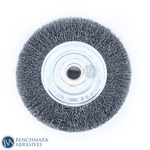
Crimped Wire Wheels
The fact that the others solely support each filament adds versatility. Ideal for work on irregular surfaces, more refined surface finishing, and light-to-medium-duty contaminant removal.
The component or workpiece base material dictates which filament to settle on, and therefore, the filament or wire size may be a feature of the finishing specifications. Another essential thing to remember is the mask distance, which producers can prefer to be short, medium, broad, or extra-large. Corners, cracks, and uneven textures work well with narrower brush faces.
Knotted Wire Wheels
Knotted wire wheel brushes feature metal wire ties or loops, usually steel or chrome steel. We help vigorous hacking and withstand twisting and movements, which may contribute to the exhaustion of the metal. Regular or twisted tuft brushes are twisted for around two-thirds of the duration of the filament.
The remaining third gets slightly flared. The loops are often twisted over their entire length for larger wire sizes and applications that require massive brushing action. Such knotted brushes of the wire wheel are classified as cable twists and are often utilized in oil pipelines and oil fields. It is often used for the surface painting of narrow channels and grooves and the pre-welding preparation of pipes. Unlike crimped wire wheel brushes with a little face, stringer bead brushes have longer trimming to end uneven corners and crevice surfaces.
Standard Twist Knot Wire Brushes
It is made with straight wire filaments twisted together to form more rigid rope- or cable-like pieces—the selection for more aggressive applications requiring higher-impact action and a rougher surface finish.
Application of Wire Wheels
Wire brushes are an excellent choice for scraping corrosion and decay, dust, slag, weld splatter, and other unwanted surface particles with angle grinders, bench grinders, or drills. For surface painting, cleaning and polishing, weld mixing, deburring, and eliminating impurities like resin, rust, or scale, wheel brushes offer a line brushing motion. For various portable grinders, desk grinders, robotic finishing equipment, or attachment to a motorized arbor during a production process, wheel brushes are perfect. The wire brush is an abrasive tool used for rust cleaning and paint removal.
Choosing The Right Type Of Wire Wheel Brushes
The following are the factors to consider when choosing the right wire wheel brushes:
-
Material: This is the first thing to consider when choosing wire wheel brushes. It refers to the type of wire used in the brush's bristles. Because it directly affects the brush's performance and applicability for various tasks, this is an important consideration when selecting a brush. Awesome materials include steel, stainless steel, brass, etc.
-
Wire Size: sometimes called wire gauges, refers to the diameter of each wire used to make a wire wheel brush. This is an important consideration when assessing the brush's aggressiveness and task-specificity. A wire with a smaller gauge describes a thicker wire, which tends to damage or scratch the delicate surfaces. A wire with the larger gauge, on the other hand, describes thin wires which are less aggressive and mostly suitable for fine work, polishing, or lighter cleaning.
-
Brush size and shape: The size and shape of the brush are also factors to consider before choosing the right wire wheel brush. The size of a brush defines the area covered and the accessibility to complex spaces. Brushes with large diameters cover large areas and are most suitable for flat and large surfaces. On the other hand, brushes with smaller diameters are perfect for intricate and fine work areas. Selecting the appropriate brush shape guarantees that the wires will make the best possible contact with the workpiece, leading to accurate and effective surface preparation or cleaning.
Various types of wire wheel brushes are available, but the device selection starts with understanding the primary modes of wire wheel: crimped and knotted.
For further inquiries, please contact us at 877-841-1837 or visit https://benchmarkabrasives.com/pages/contact-us
Join Our Newsletter
Sign up to get the latest on sales, new releases and more …Join Our Newsletter
Sign up to get the latest on sales, new releases and more …Shop Categories
Recent Articles
- Linear vs Circular Scratch Patterns: How to Control Your Finish Like a Pro
- Guide To Cross Pad Abrasive Sheets
- Understanding the Difference: T27 vs T29 Flap Discs
- Unveiling The Secrets Of Grinding Wheels: Types And Applications
- The Art Of Deburring: Techniques and Tools For Smooth Edges
- Exploring The Art Of Precision Grinding In Metalworking
- What Is The Strongest Abrasive Material?
- Bonded Abrasives Vs Coated Abrasives
- What is Electrochemical Deburring
- Are Ceramic Abrasive Products Superior?
Featured Products
-
 746 Reviews
4-1/2" x 7/8" T29 Zirconia High Density Flap Disc - 10 pack
$25.19
-
 738 Reviews
4-1/2" x .040 x 7/8" T1 Premium Thin Cut-off Wheel - 25 pack
$20.88
-
 220 Reviews
4-1/2" x 7/8" T27 Zirconia High Density Flap Disc - 10 pack
$25.19
-
 380 Reviews
6" x .045 x 7/8" T1 Premium Thin Cut-Off Wheel - 25 pack
$27.29
-
 123 Reviews
4-1/2" x 1/4" x 7/8" T27 Depressed Center Grinding Wheel - 25 pack
$28.34
-
 55 Reviews
Nonwoven 6" x 9" Scuff, Clean & Finish Hand Pads
$0.83


Blog Categories
- Abrasives
- Sanding
- Grinding Deburring Finishing
- Safety and Cleanliness
- Metal Working
- Selecting Tools And Equipment
- Wood Working
- Art And Design
- Diy Projects
- Industry 4.0
- Buffing
- Cutting Tools
- Carbide Burrs
- PPE
- Wire Brushes
- Bonded Abrasives
- TIG Electrodes
- Wire Wheels
- Bits
- Diamond Blades
- Power Brushes
- Product Reviews
- Grinding
- Finishing
- Industrial Cleaners