














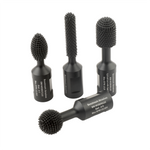













What is File Tool and Its Uses

A metal file tool is used to cut, smooth, or remove small amounts of metal, wood, plastic, or other material. From intricate jewelry-making tasks to heavy-duty industrial manufacturing, this basic hand tool is essential for shaping, polishing, and preparing materials for final assembly or use in a variety of applications.
Metal files are made in different lengths, shapes, and cuts. Every file has five divisions: the point, edge, face or cutting teeth, heel or shoulder, and tang. The tang is utilized to connect the idea about American pattern files. The tang is molded into a handle and is usually knurled on Swiss example files. American design files are utilized for fast removal of material, and where an accurate finish is not required. Grades of coarseness are jerk cut for heavier work, second-cut and smooth-cut for finishing work, and dead smooth-cut for an extra-fine finish.
Different types of file tools are used for various applications, which are as follows.
Some Common Metal File Tools and Their Uses

1. Single-cut files
This metal file tool is utilized with light tension for smooth surfaces or to put a sharp edge on cutting surfaces. With a single row of angular teeth, this metal file tool is used to create smooth surfaces with minimal stress or to sharpen cutting tools such as plane irons and chisels.
2. Double-cut file
They are used under heavier strain and where harsher finishes are admissible.
3. Bent tooth files
It is used to cut across the face and smooth surfaces of aluminum, bronze, lead, babbitt, zinc, and plastics.
4. Mill File
The mill metal file tool is tightened directly in width and thickness for around 33% of its length. They are single-cut with one whole edge. They are utilized to hone factory or circular saws and for draw-filing or finishing metals.
5. Pillar File
Pillar files are like hand documents that fit as a fiddle but are much smaller. They are double-cut with one uncut edge. Column files are utilized to file in spaces and keyways.
6. Round File
Round files tighten marginally toward the point. Round-cut files are 6 inches long. For filing circular holes or hollow surfaces, such as the inside of rings or the curved parts of machines, round-cut files -- which come in lengths of 6 inches or more -- are necessary.
7. Square File
Square files tighten marginally toward the point on all four sides and are double cut. They are utilized for filing rectangular openings and keyways.
8. Taper File
Taper files, or three-sided files, are tightened toward the point on each of the three sides. They are utilized for documenting saws having 60-degree point teeth. Tighten files come in regular, thin, extra thin, twofold extra thin, and usually are single-cut.
9. Three Square File
Three-square files are tightened toward the point on all three sides and are twofold cut. They are utilized for filing internal points and for wiping out square corners.
All the files are mainly used to finish metal surfaces. Various types of metal files are available, each with different features and uses. So, choose wisely.
Conclusion
Metal files are a simple-looking tool essential for shaping and polishing a variety of materials. Each file type has a different function, ranging from special files for intricate work to single-cut files for smooth finishing. Selecting the appropriate file ensures accuracy and effectiveness, making it a vital tool for achieving the ideal finish on any task.
Join Our Newsletter
Sign up to get the latest on sales, new releases and more …Join Our Newsletter
Sign up to get the latest on sales, new releases and more …Shop Categories
Recent Articles
Featured Products
-
 746 Reviews
4-1/2" x 7/8" T29 Zirconia High Density Flap Disc - 10 pack
$25.19
-
 738 Reviews
4-1/2" x .040 x 7/8" T1 Premium Thin Cut-off Wheel - 25 pack
$20.88
-
 220 Reviews
4-1/2" x 7/8" T27 Zirconia High Density Flap Disc - 10 pack
$25.19
-
 380 Reviews
6" x .045 x 7/8" T1 Premium Thin Cut-Off Wheel - 25 pack
$27.29
-
 123 Reviews
4-1/2" x 1/4" x 7/8" T27 Depressed Center Grinding Wheel - 25 pack
$28.34
-
 55 Reviews
Nonwoven 6" x 9" Scuff, Clean & Finish Hand Pads
$0.83


Blog Categories
- Abrasives
- Sanding
- Grinding Deburring Finishing
- Safety and Cleanliness
- Metal Working
- Selecting Tools And Equipment
- Wood Working
- Art And Design
- Diy Projects
- Industry 4.0
- Buffing
- Cutting Tools
- Carbide Burrs
- PPE
- Wire Brushes
- Bonded Abrasives
- TIG Electrodes
- Wire Wheels
- Bits
- Diamond Blades
- Power Brushes
- Product Reviews
- Grinding
- Finishing
- Industrial Cleaners