



























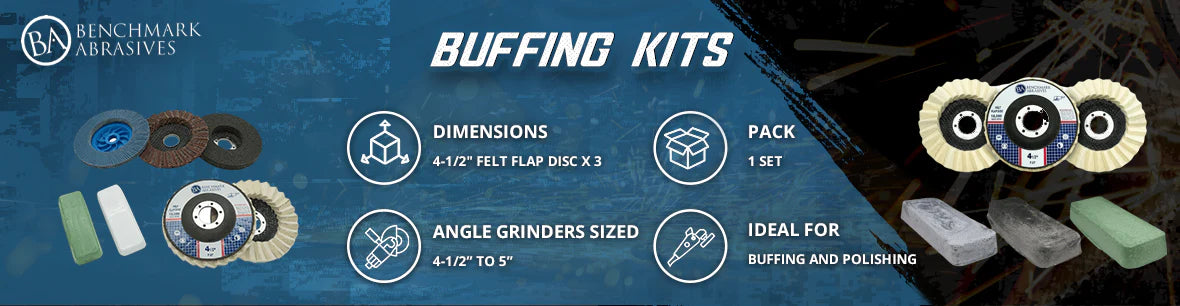
Buffing Kits
-

Brass & Copper 3-Step Buffing Kit For Die Grinder – 2”
Original price $49.34 - Original price $49.34Original price$49.34$49.34 - $49.34Current price $49.34Product Specification Shipping Refund Product Specification Brass & Copper 3-Step Buffing Kit For Die Grinder – 2” Included in this kit: 2" ...
View full detailsOriginal price $49.34 - Original price $49.34Original price$49.34$49.34 - $49.34Current price $49.34 -

Hard Metals 4-Step Buffing Kit For Hand Held Drills
Original price $67.19 - Original price $67.19Original price$67.19$67.19 - $67.19Current price $67.19Product Specification Shipping Refund Product Specification Hard Metals 4-Step Buffing Kit For Hand Held Drills Included in this kit: 4” x ¼” man...
View full detailsOriginal price $67.19 - Original price $67.19Original price$67.19$67.19 - $67.19Current price $67.19 -

Nickel & Chrome 3-Step Buffing Kit For Bench Grinders
Original price $66.14 - Original price $66.14Original price$66.14$66.14 - $66.14Current price $66.14Product Specification Shipping Refund Product Specification Nickel & Chrome 3-Step Buffing Kit For Bench Grinders Included in this kit: 6” x ...
View full detailsOriginal price $66.14 - Original price $66.14Original price$66.14$66.14 - $66.14Current price $66.14 -

Nickel & Chrome 3-Step Buffing Kit For Hand Held Drills
Original price $56.69 - Original price $56.69Original price$56.69$56.69 - $56.69Current price $56.69Product Specification Shipping Refund Product Specification Nickel & Chrome 3-Step Buffing Kit For Hand Held Drills Included in this kit: 4” ...
View full detailsOriginal price $56.69 - Original price $56.69Original price$56.69$56.69 - $56.69Current price $56.69 -

Nickel & Chrome 3-Step Buffing Kit For Die Grinder – 2”
Original price $49.34 - Original price $49.34Original price$49.34$49.34 - $49.34Current price $49.34Product Specification Shipping Refund Product Specification Nickel & Chrome 3-Step Buffing Kit For Die Grinder – 2” Included in this kit: 2" ...
View full detailsOriginal price $49.34 - Original price $49.34Original price$49.34$49.34 - $49.34Current price $49.34 -

Nickel & Chrome 3-Step Buffing Kit For Angle Grinder
Original price $47.24 - Original price $47.24Original price$47.24$47.24 - $47.24Current price $47.24Product Specification Shipping Refund Product Specification Nickel & Chrome 3-Step Buffing Kit For Angle Grinder Included in this kit: 4-1/2"...
View full detailsOriginal price $47.24 - Original price $47.24Original price$47.24$47.24 - $47.24Current price $47.24 -

Precious Metals/Jewelry 2-Step Buffing Kit For Angle Grinder
Original price $44.09 - Original price $44.09Original price$44.09$44.09 - $44.09Current price $44.09Product Specification Shipping Refund Product Specification Precious Metals/Jewelry 2-Step Buffing Kit For Angle Grinder Included in this kit: ...
View full detailsOriginal price $44.09 - Original price $44.09Original price$44.09$44.09 - $44.09Current price $44.09 -

Brass & Copper 3-Step Buffing Kit For Die Grinder – 3”
Original price $55.64 - Original price $55.64Original price$55.64$55.64 - $55.64Current price $55.64Product Specification Shipping Refund Product Specification Brass & Copper 3-Step Buffing Kit For Die Grinder – 3” Included in this kit: 3" ...
View full detailsOriginal price $55.64 - Original price $55.64Original price$55.64$55.64 - $55.64Current price $55.64 -

Precious Metals/Jewelry 2-Step Buffing Kit For Die Grinder – 3”
Original price $52.49 - Original price $52.49Original price$52.49$52.49 - $52.49Current price $52.49Product Specification Shipping Refund Product Specification Precious Metals/Jewelry 2-Step Buffing Kit For Die Grinder – 3” Included in this kit:...
View full detailsOriginal price $52.49 - Original price $52.49Original price$52.49$52.49 - $52.49Current price $52.49 -

Precious Metals/Jewelry 2-Step Buffing Kit For Bench Grinders
Original price $62.99 - Original price $62.99Original price$62.99$62.99 - $62.99Current price $62.99Product Specification Shipping Refund Product Specification Precious Metals/Jewelry 2-Step Buffing Kit For Bench Grinders Included in this kit: 6...
View full detailsOriginal price $62.99 - Original price $62.99Original price$62.99$62.99 - $62.99Current price $62.99 -

Precious Metals/Jewelry 2-Step Buffing Kit For Hand Held Drills
Original price $53.54 - Original price $53.54Original price$53.54$53.54 - $53.54Current price $53.54Product Specification Shipping Refund Product Specification Precious Metals/Jewelry 2-Step Buffing Kit For Hand Held Drills Included in this kit:...
View full detailsOriginal price $53.54 - Original price $53.54Original price$53.54$53.54 - $53.54Current price $53.54 -

Precious Metals/Jewelry 2-Step Buffing Kit For Die Grinder – 2”
Original price $46.19 - Original price $46.19Original price$46.19$46.19 - $46.19Current price $46.19Product Specification Shipping Refund Product Specification Precious Metals/Jewelry 2-Step Buffing Kit For Die Grinder – 2” Included in this kit...
View full detailsOriginal price $46.19 - Original price $46.19Original price$46.19$46.19 - $46.19Current price $46.19


Buffing Kits for Aluminum, Stainless, and Chrome
Metal finishing starts with having the right components working together. Benchmark Abrasives provides matched buffing kits that simplify the cut, color, and finish process. These metal-specific collections eliminate the hassle of sourcing individual wheels and compounds, giving beginners and pros a direct path to predictable, mirror-like results.
Choosing the right system depends on your target metal and whether you use an angle grinder or a stationary bench buffer.
Professional-Grade Quality Direct to You
Our customers choose Benchmark Abrasives for the value and reliability we put behind every product:
-
25+ Years in the industrial abrasives industry
- Up to 60% savings compared to traditional retail pricing
- 24-hour shipping on most in-stock nationwide orders
- 1,800+ verified reviews across Amazon and our storefront
- Super Points Rewards earned on every purchase
Understanding Your Metal Polishing Kit Components
Professional buffing kits contain three essential components: airway wheels of varying firmness, solid abrasive compounds, and the adapters or arbors needed to mount them to your power tool. Achieving a clean mirror finish requires matching these parts to the job, as wheels cannot polish metal without the correct compound.
The entire process relies on a strict three-step progression:
- Cutting: A stiff wheel and aggressive compound strip away deep scratches and sanding marks.
- Coloring: A medium-density wheel and intermediate compound blend out micro-scratches to clear up surface haze.
- Finishing: A soft flannel wheel and fine gloss compound bring out the final reflective shine.
If you run out of consumables, you can restock individual bars from the buffing compounds collection. For a deeper look at color-coded grits, read the guide to buffing compounds and their uses to choose the right setup for your machine.
Match Your Metal, Tool, and Project Goal
Select your buffing kit by matching your metal to your project goals. First, identify your material. Next, choose your goal: heavy oxidation requires a cut-to-color sequence, while minor hazing needs only a light refining pass. Finally, match the kit to your tool.
Use the guide below to match your metal type to the right compound sequence:
-
Aluminum: Cut level High to Fine, Tripoli to White Rouge progression, Grinder or Bench Buffer, best for tanks and wheels.
-
Stainless Steel: Cut level Max to Fine, Emery to Green Chrome progression, Variable-Speed Grinder, best for marine applications and welds.
-
Chrome: Cut level Low, Blue to White Rouge progression, Drill or Bench Buffer, best for trim and emblems.
Always dedicate each buffing wheel to a single compound stage to avoid cross-contamination. Mixing coarse and fine compounds on one wheel causes deep micro-scratches during final passes. Proper tool speeds and pressures extend wheel life and ensure a flawless finish.
Browse Buffing Kits by Metal Type
Selecting Your Metal-Specific Polishing Kit
Success with any buffing kit depends on matching the compound and wheel directly to metal hardness. Different metals react differently to friction and heat.
Aluminum Polishing Kits
These setups are optimized for fast cut speed on soft surfaces that easily load up wheels. Aluminum requires light pressure and a cool run to prevent tearing. The typical progression moves from coarse Tripoli to intermediate White Rouge, ending with a soft flannel wheel.
Stainless Steel Polishing Kits
Harder metals require kits designed for heat control to avoid yellow tinting. The progression demands aggressive Black Emery for defect removal, followed by Green Chrome to burnish the surface. For detailed techniques, review our guide on how to polish stainless steel.
Chrome and High-Color Finishing Kits
These kits are optimized for final gloss and cleanliness on thin plating. The process relies on light, steady passes with fine Blue Rouge on soft cotton wheels to pull out deep reflections safely.
Selecting the correct progression ensures your project moves smoothly from raw preparation to a mirror finish.
Safety, Speed, and Prep: Avoiding Common Buffing Failures
Matching your tools to the job prevents the most common setup mistakes. Here is what to know before you start.
Choosing the Right Tool
Use a stationary bench buffer for small, handheld parts to maintain dual-handed control. For large panels or vehicle tanks, use a portable angle grinder to maneuver across wide surfaces.
RPM and Safety
Most fixed-speed angle grinders run at 10,000 RPM, which exceeds the safe limit for standard cotton wheels. Always check the wheel's max-RPM stamp and use variable-speed tools adjusted to 3,000 to 6,000 RPM to avoid wheel failure.
Prep and Contamination
Polishing cannot remove deep scratches, so sand surfaces up to 400-grit before buffing. Use one wheel per compound to prevent cross-contamination, and clean wheels regularly with a wheel rake. Sourcing dedicated buffing wheels for each step protects your finish.
Answers to Common Metal Polishing Questions
1. What is the difference between a buffing kit and a metal polishing kit?
In the metalworking industry, buffing and polishing are often used interchangeably, but they refer to different finishing stages. A buffing kit focuses on the abrasive stage, using coarser wheels and cutting compounds to level out surface scratches. A metal polishing kit focuses on the final stages, using soft flannel wheels and fine rouges to pull out a brilliant mirror shine.
2. Can I use a buffing kit on a fixed-speed angle grinder?
Standard buffing wheels are not rated for fixed-speed angle grinders, which typically run over 10,000 RPM. At that speed, cotton wheels can disintegrate and become a safety hazard. Always verify the maximum RPM rating stamped on your wheels and match them to a variable-speed grinder set between 3,000 and 6,000 RPM.
3. What compound sequence should I follow for a mirror finishing kit?
To achieve a flawless mirror finish, follow the correct cut, color, and finish sequence. Start with a coarse cutting compound like black emery or tripoli on a stiff airway wheel to level surface defects. Transition to a medium-grade compound like white rouge to color the metal, then finish with fine green chrome on a soft flannel wheel.
4. Do I need to sand before using a buffing kit?
Sanding is a critical preparation step because buffing compounds refine surfaces rather than remove deep scratches. Trying to buff out heavy gouges will only waste your compound and wear down your wheels prematurely. Sand your workpiece progressively up to 400-grit before starting your first heavy cutting pass.
5. How do I prevent cross-contamination between compounds?
Cross-contamination occurs when coarse abrasive particles transfer to a finishing wheel, leaving micro-scratches on your polished metal. To prevent this, dedicate one specific buffing wheel to each compound stage and label them. Wipe down the workpiece thoroughly between stages and use a wheel rake regularly to keep wheels clean.
6. I am polishing stainless steel. How do I avoid heat tint or discoloration?
Stainless steel is highly sensitive to heat, which causes yellow or blue surface discoloration when the metal gets too hot. Avoid this tint by using short, light passes instead of lingering in one spot with heavy pressure. Keep your tool speed under 6,000 RPM and review our guide on how to polish stainless steel for more step-by-step techniques.
Benchmark Abrasives offers buffing kits matched to your metal, your tool, and your finishing goal. Whether you are starting with aluminum, tackling stainless steel welds, or restoring chrome trim, you will find a complete kit ready to take you from raw prep to mirror finish.