














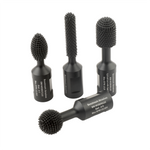












What are Cartridge Rolls, Types, and Their Applications

Cartridge rolls are specialized coated abrasive tools designed for sanding, deburring, and finishing in spaces that are inaccessible to larger diameter discs or wheels. These tools are composed of abrasive cloth strips wrapped tightly around a central core. As the outer layer of the abrasive wears down during use, it deflects and sheds to reveal a fresh, sharp layer of mineral underneath.
Because of their small diameters, cartridge rolls must be used on high-speed rotary tools or die grinders to achieve the necessary surface feet per minute (SFPM) for efficient metal removal. They are essential for porting engines, cleaning up castings, and smoothing internal weld seams.
The Engineering of a Cartridge Roll
The primary advantage of a cartridge roll over a standard sanding sleeve is its multi-layer helical construction. While a sanding sleeve is a single layer that must be discarded once dull, a cartridge roll acts as a "renewable" tool.
The wear cycle of the cartridge roll is determined by the resin bond and the backing fabric. High-quality cartridge rolls use a heavy-duty X-weight or J-weight cotton backing that is brittle enough to wear away at a controlled rate. If the backing were too strong, the dull grains would stay in place, causing the tool to "load" with metal debris and overheat.
Instead, the friction of the grinding process causes the outer wrap to gradually fray and peel back, constantly providing the operator with a new cutting surface. This ensures a consistent cut rate and finish throughout the entire life of the roll, right down to the center core.
Technical Considerations: Mandrel Pilot and Safety
To operate safely at speeds often exceeding 20,000 RPM, cartridge rolls must be mounted on a specific mandrel. The mandrel features a "pilot"—the threaded or smooth rod that inserts into the center of the roll. It is a critical technical requirement that the pilot length matches the length of the cartridge roll.
If the pilot is too short, the roll will lack internal support at the tip, leading to excessive vibration, "wandering," or even the roll snapping off the mandrel. Conversely, the mandrel must be tightened sufficiently to prevent the roll from spinning independently of the shaft. Always verify the maximum RPM rating of both the roll and the mandrel. Because of their small mass, these tools can become dangerous projectiles if the centrifugal force exceeds the adhesive strength of the internal bond.
Types of Cartridge Rolls
The shape of the roll determines its ability to navigate complex internal geometries.
Straight Cartridge Rolls: Straight rolls are uniform in diameter from top to bottom. They are the standard choice for finishing the inside diameters of pipes, smoothing out dead-end holes, and lapping operations. Because they have a consistent surface area, they provide a very predictable finish when blending flat internal surfaces.
Tapered Cartridge Rolls: Tapered cartridge rolls feature a cone-like profile that narrows toward the tip. These are specifically designed for working in fillets and irregular contours. When held at a 45-degree angle, the tapered point can reach deep into corners where a straight roll would be too bulky. As the angle of the tool is decreased relative to the workpiece, more abrasive surface area makes contact, allowing for faster material removal.
Tapered Cone Points: These are high-precision versions of the tapered roll, often used for delicate deburring and polishing of composites and high-tensile alloys. Their sharp point allows for extreme accessibility in the smallest crevices of a workpiece, making them a favorite in the aerospace and medical device manufacturing sectors.
Primary Applications of Cartridge Rolls

Cartridge rolls excel in "edge breaking" and removing the "flash" (excess material) left behind by molding or machining processes. Common applications include:
- Porting and Polishing: Modifying intake and exhaust ports in engine heads to improve airflow.
- Tool Mark Removal: Displacing the ridges left by end mills or lathes on internal surfaces.
- Deburring: Removing sharp burrs from the inside of cross-drilled holes.
- Weld Blending: Smoothing out the "bead" in the corners of fabricated boxes or frames.
Because they are usually made with aluminum oxide, zirconium, or ceramic grains, they can handle everything from soft aluminum to high-carbon steel. Ceramic oxide rolls are particularly valued for their cool-cutting properties on heat-sensitive metals like stainless steel.
Read More: Applications of Cartridge Rolls
Availability and Sizing
Cartridge rolls are typically available in diameters ranging from 1/4 inch (6mm) to 3/4 inch (19mm) and lengths from 1 inch (25mm) to 2 inches (50mm). Choosing the correct grit is also vital:
- 36 - 60 Grit: For heavy deburring and flash removal.
- 80 - 120 Grit: For blending tool marks and surface preparation.
- 180 - 320 Grit: For final polishing and fine finishing.
Conclusion
Cartridge rolls are the ultimate solution for "internal" abrasive challenges. By understanding the self-renewing wear cycle of the helical layers and ensuring proper mandrel support, metalworkers can achieve high-speed precision in spaces where traditional abrasives simply cannot fit. Whether using a straight roll for a bore or a tapered point for a fillet, these tools provide a dynamic and efficient method for refined metal finishing.
Join Our Newsletter
Sign up to get the latest on sales, new releases and more …Join Our Newsletter
Sign up to get the latest on sales, new releases and more …Shop Categories
Recent Articles
- Bryce Green (Big Kid Custom Rides)
- Marc Rapaport (Studio Rapaport)
- Ben Evilsizor (Naxja Winterfest)
- Justin Stauffer (J&E's Fine Woodworking)
- Jaybird (Lost Souls Customz)
- James Lowery (Veteran MX Throttle Therapy)
- John Kovalcik (@olddogmetalworks)
- Tommy Mazz (@jln_weldingservice_)
- Ivan Lopez
- Jeremy Werkheiser (@metalrelic)
Featured Products
-
 734 Reviews
4-1/2" x .040 x 7/8" T1 Premium Thin Cut-off Wheel - 25 pack
$20.88
-
 746 Reviews
4-1/2" x 7/8" T29 Zirconia High Density Flap Disc - 10 pack
$25.19
-
 220 Reviews
4-1/2" x 7/8" T27 Zirconia High Density Flap Disc - 10 pack
$25.19
-
 380 Reviews
6" x .045 x 7/8" T1 Premium Thin Cut-Off Wheel - 25 pack
$27.29
-
 123 Reviews
4-1/2" x 1/4" x 7/8" T27 Depressed Center Grinding Wheel - 25 pack
$28.34
-
 55 Reviews
Nonwoven 6" x 9" Scuff, Clean & Finish Hand Pads
$0.83


Blog Categories
- Abrasives
- Sanding
- Grinding Deburring Finishing
- Safety and Cleanliness
- Metal Working
- Selecting Tools And Equipment
- Wood Working
- Art And Design
- Diy Projects
- Industry 4.0
- Buffing
- Cutting Tools
- Carbide Burrs
- PPE
- Wire Brushes
- Bonded Abrasives
- TIG Electrodes
- Wire Wheels
- Bits
- Diamond Blades
- Power Brushes
- Product Reviews
- Grinding
- Finishing
- Industrial Cleaners