



























Surface Conditioning Discs: A Fabricator's Guide

You grab a maroon disc expecting a clean, satin finish on a stainless weld, but end up with a cloudy, uneven surface because the grade didn't match your workflow. Sorting out "maroon versus blue" or finding Scotch-Brite equivalents shouldn't feel like guesswork on a busy shop floor.
Choosing the right surface conditioning discs is the difference between a flawless blend and wasted hours of rework. This guide gives you a clear selection framework to get uniform finishes faster with fewer mistakes. We cover what non-woven abrasives actually do, walk through a conditioning disc grit chart, and compare aluminum oxide versus silicon carbide for steel, stainless, and aluminum. You'll also get safe setup basics for RPM, pressure, and angle.
The Real Job of Surface Conditioning Discs
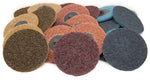
Many fabricators treat surface conditioning discs like standard sanding discs. These tools are actually designed for controlled surface improvement with virtually zero stock removal. Made from synthetic nylon fibers woven into a three-dimensional web and impregnated with abrasive minerals, their open structure prevents loading while conforming to irregular workpieces.
They excel at specific tasks: clearing light oxidation, softening sharp edges during deburring, blending weld lines, and prepping surfaces for paint.
To keep your workflow efficient, know how they compare to other shop staples:
- Flap Discs: Shape and remove material first; use conditioning discs to blend after.
- Fiber Discs: Level welds rapidly; conditioning discs apply the final, uniform satin finish.
- Wire Wheels: Clean aggressively but risk gouging; conditioning discs offer safer, more predictable control.
If your project requires aggressive stock removal first, browse our coated abrasive hook and loop discs for grit-controlled leveling before you finish.
Demystifying the Surface Conditioning Disc Grit Chart: Colors vs. Real Grits
A single "medium" non-woven disc can span an equivalent range of up to 70 traditional grit sizes. Because nylon fibers cushion the abrasive grains, surface conditioning discs operate in broad performance ranges rather than a single, fixed grit. Always verify the manufacturer's grade label to confirm consistency across batches.
Use this conditioning disc grit chart as a practical shop floor guideline:
- Brown/Tan — Coarse / Extra Coarse: Heavy cleaning, scale removal, light deburring. Approx. Coated grit range: ~40–80.
- Maroon/Red — Medium: General surface prep, weld blending. Approx. Coated grit range: ~80–150.
- Blue — Fine / Very Fine: Satin finishing, blending transition lines. Approx. Coated grit range: ~150–320.
- Grey — Ultra / Super Fine: Final polish prep, ultra-light cleaning. Approx. coated grit range: ~320–800+.
Two practical rules for your shop:
- If you can see deep flap-disc scratches, drop a grade coarser briefly to level the valleys, then step back up.
- If you're prepping metal for paint or powder, prioritize a uniform scratch pattern over a high-shine finish.
If stainless is turning gold or blue while you finish, read our guide on reducing heat discoloration during stainless steel grinding — heat control matters as much as grit selection.
Matching Surface Conditioning Discs to Your Tool and Job
Shredding a standard non-woven disc on a sharp corner is a fast way to waste material. Matching your disc format and attachment style to the tool and application keeps your workflow efficient.
Use this quick-selection guide to pair your tool with the right disc construction:
- 2"–3" Quick Change (SC): Die grinder detail work, corners, and weld toes.
- 5"–7" Hook & Loop: DA sanders or grinders on large, flat surfaces.
- Flap Discs: Angle grinder blending with extended service life.
- Unitized: Hard edges and heavy deburring without tearing.
- Strip & Clean: Open web for rapid paint, rust, and scale stripping.
If you search for "Scotch-Brite" discs, know it's a brand term. Most shops map industry grades directly to generic alternatives: CRS (Coarse), MED (Medium), VFN (Very Fine), and UFN/SFN (Ultra/Super Fine).
Standard non-woven discs excel at cosmetic blending and light edge breaks. If your job requires structural deburring on sharp edges, choose dense unitized options to prevent tearing.
Browse our complete lineup of surface conditioning discs to upgrade your metal finishing setup, or visit our paint and rust stripping collection for highly aggressive coating removal.
Choosing Your Mineral: Aluminum Oxide vs. Silicon Carbide
Picking a coarser grade isn't always the fastest way to fix a stubborn finish. Choosing the wrong mineral on your surface conditioning discs will ruin a workpiece regardless of grit. While grade controls scratch depth, mineral type dictates how it cuts and behaves on the metal.
Match your mineral to the application:
- Mild Steel: Aluminum Oxide (AO) is the durable, tough default for general cleaning and blending.
- Stainless Steel: Use AO rated for stainless. Never reuse a carbon-steel-loaded disc, which introduces rust. Review how to reduce heat discoloration during stainless grinding.
- Aluminum: Silicon Carbide (SiC) cuts more sharply on soft alloys. Apply light pressure to prevent loading.
- Mixed-Metal Shops: Color-code storage bins to prevent cross-contamination.
For final details after power conditioning, switch to buffing products and hand pads to blend by hand.
Choosing the right surface conditioning discs comes down to controlling scratch patterns and heat — not heavy stock removal. To get a predictable satin finish on every job, run through this five-step checklist before mounting your next disc:
- Define your goal: Determine if you need to strip paint, clean rust, deburr edges, blend welds, or apply a final finish.
- Select the format: Use quick-change Roloc discs for tight spaces, hook-and-loop for flat panels, flap-style for blending, or unitized wheels for edges.
- Identify the grade: Match your finishing target to the industry-standard color-coded system, moving progressively from coarse to ultra-fine.
- Select the mineral: Use tough aluminum oxide for steel and stainless, but switch to sharp silicon carbide for non-ferrous alloys.
- Verify speed and pressure: Confirm the disc's rated RPM meets or exceeds your tool's no-load speed. Apply light pressure and keep moving.
To avoid costly rework, always test your sequence on scrap metal first and step through grades progressively.
Shop Surface Conditioning Discs
Frequently Asked Questions
What is the difference between a surface conditioning disc and a flap disc?
A flap disc is designed for aggressive material removal, grinding, and shaping, while a surface conditioning disc is built for blending and refining without removing base metal. Flap discs use rigid, coated abrasive flaps; surface conditioning discs use a flexible, non-woven nylon web. Best practice: use a flap disc first to level a weld, then follow up with a surface conditioning disc to blend transition lines.
Are non-woven abrasive discs the same as Scotch-Brite discs?
Yes, they're structurally the same. Scotch-Brite is a registered brand name owned by 3M, while "non-woven abrasive" is the generic industry term for the synthetic fiber construction. To match performance across brands, look at the industry grade names. Map Scotch-Brite grits to generic equivalents by matching Coarse (CRS), Medium (MED), Very Fine (VFN), or Ultra Fine (UFN).
What RPM should I run a 2 inch, 3 inch, 4.5 inch, or 7 inch surface conditioning disc at?
Always match your tool's no-load speed to the maximum RPM printed on the disc label. Never exceed this rated limit — running too fast melts the nylon fibers. Disc diameter sets safe operating limits. A small 2-inch quick-change disc can safely run up to 12,000 RPM, while a larger 7-inch disc typically requires speeds under 6,000 RPM.
Which disc is best for paint and rust removal: strip discs or standard surface conditioning discs?
Strip and clean discs are the right call for heavy rust and paint, thanks to their highly open, rigid web design. Standard surface conditioning discs will quickly clog or load up on thick coatings. Use an aggressive strip disc first to clear scale. Many manufacturers, including Benchmark Abrasives, offer dedicated clean and strip products — follow those with a medium conditioning disc for final paint prep.
Can I replace sandpaper grit numbers with the conditioning disc grit chart?
No. Non-woven abrasives produce a much shallower scratch than rigid sandpaper of the same grit. The air-cushioned nylon web distributes pressure, making a single medium disc span a wide range of traditional grits. Use the comparison chart only as a starting point. For spec-critical jobs requiring precise mechanical bonding profiles, stick to exact coated sandpaper grit numbers.
Why do my surface conditioning discs load up, glaze, or stop cutting?
This is usually caused by too much downward pressure, dwelling too long in one spot, or running at excessively high speeds. These factors generate frictional heat, which melts the synthetic nylon backing and glazes the abrasive grains. Let the tool's weight do the work and keep the grinder moving. If glazing continues, reduce your speed or change your abrasive grade.
Need help choosing the right setup for your next metalworking project? Browse our full surface conditioning collection to find the perfect match for your tools.
Join Our Newsletter
Sign up to get the latest on sales, new releases and more …Join Our Newsletter
Sign up to get the latest on sales, new releases and more …Shop Categories
Recent Articles
- Resin Fiber Discs vs Flap Discs: When Should You Use Each?
- Best Abrasives for Rust Removal on Steel
- Cut-Off Wheels vs Band Saws: Which is Better for Metal Cutting
- How to Optimize RPM Abrasive Disc Performance & Lifespan
- Surface Conditioning Discs: A Fabricator's Guide
- Best Flap Disc for Stainless Steel: Complete Fabricator’s Guide
- Ceramic vs Zirconia Flap Discs: Which Performs Better for Metal Fabrication
- How to Choose the Right Grit for Metal Sanding Projects
- Tools Collection for Fabrication and Abrasive Workflows
- How to Choose the Right Diamond Blade
Featured Products
-
 746 Reviews
4-1/2" x 7/8" T29 Zirconia High Density Flap Disc - 10 pack
$25.19
-
 738 Reviews
4-1/2" x .040" x 7/8" t1 premium thin cut-off wheel - 25 pack
$20.88
-
 220 Reviews
4-1/2" x 7/8" T27 Zirconia High Density Flap Disc - 10 pack
$25.19
-
 380 Reviews
6" x .045 x 7/8" T1 Premium Thin Cut-Off Wheel - 25 pack
$27.29
-
 55 Reviews
Nonwoven 6" X 9" Scuff, Clean & Finish Hand Pads
$0.83
-
 123 Reviews
4-1/2" x 1/4" x 7/8" T27 Depressed Center Grinding Wheel - 25 pack
$28.34


Blog Categories
- Abrasives
- Sanding
- Grinding Deburring Finishing
- Safety and Cleanliness
- Metal Working
- Selecting Tools And Equipment
- Wood Working
- Art And Design
- Diy Projects
- Industry 4.0
- Buffing
- Cutting Tools
- Carbide Burrs
- PPE
- Wire Brushes
- Bonded Abrasives
- TIG Electrodes
- Wire Wheels
- Bits
- Diamond Blades
- Power Brushes
- Product Reviews
- Grinding
- Finishing
- Industrial Cleaners