



























Best Surface Conditioning Product for Weld Removal

In the world of modern metal fabrication, the weld is the heart of the structure, but it is often the "ugly duckling" of the aesthetic finish. The challenge of weld removal lies in finding the balance between speed and precision. If you grind too aggressively, you risk gouging the workpiece; if you are too cautious, you waste valuable labor hours.
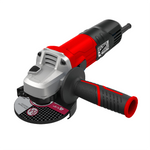
Choosing the right surface conditioning product for weld removal is what distinguishes a professional, seamless finish from a haphazard job that requires hours of rework. The right choice in abrasives impacts your efficiency, the final finish quality, and your bottom line. Whether you are using a high-torque angle grinder or a precision die grinder, the way you pair your power tools with the right abrasive determines how easily you can transform raw metal surfaces into something shop-ready.
What is Surface Conditioning and Why Does It Matter for Weld Removal?
Surface conditioning is often mistaken for just "fine-tuning," but it is a different category of abrasive technology. Unlike traditional coated abrasives (like sandpaper) that feature a single layer of grain on a flat backing, non-woven surface abrasives consist of a three-dimensional web of nylon fibers impregnated with abrasive grains.
Why It Outperforms Standard Grinding
Heat Buildup Management: The open-web structure allows air to circulate, significantly reducing heat buildup that can warp thin sheet metal.
Controlled Scratch Pattern: Instead of deep, jagged gouges, surface conditioning products leave a uniform scratch pattern that is much easier to blend or polish.
Surface Finishing: It allows for a one-step approach to blending a weld bead into the surrounding metal, preserving the structural integrity of the workpiece.
During the grinding process, the goal is to achieve the best results with the least amount of material distortion. Surface conditioning products allow for a more forgiving experience, especially on delicate finishes where over-grinding can be a costly mistake.
Types of Surface Conditioning Products for Weld Removal
Not every weld is the same, and neither is every tool. Choosing the right format is the first step toward efficiency.
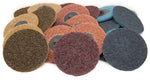
Quick Change Discs for Fast Weld Blending
Ideal for use with a die grinder, quick-change discs are the "special forces" of weld removal. They are perfect for reaching into tight corners or working on small-scale metalwork.
- High-speed performance allows for rapid blending of small weld seams.
- They reduce operator fatigue by allowing for "tool-free" swaps when moving between grits.
Best to use for: Blending welds in restricted areas where a larger grinder can't fit.
Unitized Wheels for Consistent Finishing
Compressing layers of non-woven material creates unitized wheels into a dense, solid wheel. These wheels are best for controlled surface prep and finishing.
- They maintain a consistent finish even as the wheel wears down.
- Ideal for final finishing, they are less aggressive than a grinding wheel but tougher than a standard pad.
Best to use for: Deburring and achieving a high-quality finish on machined parts.
Flap Wheels and Non-Woven Drums
When working in a large fabrication shop, you often encounter irregular shapes or large sections of sheet metal.
- A flap wheel provides enough flex to follow contours without flattening them.
- Non-woven drums are the powerhouse for wide-area surface blending.
Best to use for: Restoring a "brushed" finish to stainless steel after a weld is removed.
Hand Pads for Detail Work
Sometimes, power isn't the answer. Hand pads are essential for manual touch-ups and cleaning sharp edges.
They allow for tactile feedback on the work surface.
Best to use for: Removing weld spatter and cleaning the right surface before inspection.
Surface Conditioning Belts for Larger Jobs
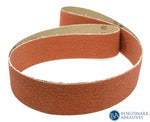
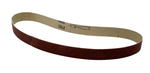
For high-volume production, a sanding belt (specifically a non-woven conditioning belt) is the most efficient choice for material removal.
- Used on backstand tools for large-scale metal part finishing.
- Highly effective at removing excess material from a heavy weld across long stretches.
Best to use for: Structural industrial applications.
How to Choose the Best Surface Conditioning Product for Weld Removal
Material Type
The material type shows the chemistry of the abrasive.
- Carbon Steel and Mild Steel: These ferrous metals can handle more aggressive grains.
- Stainless Steel: Requires products that resist loading and minimize heat tint.
- Powder Coating Prep: If the part is headed for powder coating, you need a coarser scratch pattern to ensure paint adhesion.
Weld Size and Severity
For a heavy stock removal job, like a massive structural weld, you cannot start with surface conditioning. You must use a grinding wheel or flap disc to knock down the excess material first. Surface conditioning is designed for weld seams and removing weld spatter to leave a smooth, paint-ready surface.
Desired Finish and Appearance
Are you looking for an industrial finish or a mirror finish?
- Coarse Grit: For blending and initial surface prep.
- Finer Grit: To move toward a smooth finish or a high-quality finish.
Read More: Abrasive Grit Guide for Sanding Discs and Metalworkers
Tool Compatibility
Always match the product to the tool's maximum RPM.
- An angle grinder usually runs at higher speeds than a die grinder.
- Using a tool at speeds higher than its rating is a major safety hazard.
Best Practices for Weld Removal and Surface Conditioning
To achieve a consistent finish without damaging the workpiece, follow this professional workflow:
-
Weld Knockdown (The First Step): Use an abrasive disc to grind the weld down until it is just above the metal surface.
-
For the next step, select a medium-grit surface conditioning disc for blending.
-
Conditioning: Use a fine-grit non-woven product to match the surrounding metal texture.
Safety Tip: Always wear a full face shield and high-impact gloves. Non-woven products can "grab" onto sharp edges, potentially causing the tool to kick back.
To prevent heat discoloration and heat tint, use light pressure and keep the tool moving. Weld discoloration is often caused by staying in one spot too long, which ruins the material integrity.
Comparing Abrasive Grains for Weld Removal
Zirconia Alumina: A reliable grain that is highly effective for working with ferrous metals and carbon steel. It offers a good balance of product life and cutting speed.
Ceramic Alumina: The high-performance leader. Ceramic grain is designed to microfracture, staying sharp throughout the disc's life. It is the best choice for stainless steel because it cuts cooler and faster.
Common Mistakes to Avoid
- Using the wrong product type: Trying to use a fine-grit hand pad to remove a structural weld will only result in a ruined pad and a frustrated operator.
- Skipping grit progression: Moving from a coarse grinding wheel to a fine conditioning pad van gives you surface invisible scratches.
- Excessive heat buildup: Pushing too hard on the workpiece creates friction that the non-woven fibers can't dissipate, leading to "smearing" of the nylon.
Best Uses by Industry and Application
Throughout the United States, these products are foundational in:
- Metal Fabrication Shops: For finishing furniture, railings, and architectural metal.
- Automotive Refinishing: For blending welds on body panels without thinning the metal too much.
- Industrial Applications: For maintaining large-scale machinery and tanks.
FAQs
What is the best surface conditioning product for weld removal?
For light welds or blending, a quick-change disc on a die grinder is often the best. For large-scale flat surfaces, a non-woven sanding belt is superior.
Can surface conditioning replace grinding for weld removal?
Only for very small TIG welds or thin sheet metal, where there is very little excess material. For heavy MIG welds, you must grind first.
What grit should I use for blending welds?
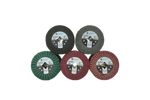
Start with a "Coarse" (Brown) or "Medium" (Maroon) surface conditioning product to blend the initial grind marks, then move to "Very Fine" (Blue/Gray) for a smooth finish.
How do I prevent heat discoloration during weld removal?
Use a ceramic alumina grain, reduce your pressure, and ensure your power tools are running at the correct tool speeds.
Are surface conditioning products good for stainless steel?
Yes, they are the right choice for stainless steel because they run cooler and help preserve the metal's corrosion resistance.
Build a Better Finish: Choose the Right Surface Conditioning Solution
In the end, efficiency in metal fabrication is about reducing labor costs and increasing output. By selecting the right surface conditioning product, you reduce the number of steps required to reach a high-quality finish.
- Match your abrasive to the material type and weld size.
- Invest in high-performance grains like ceramic alumina for tough alloys.
- Follow best practices to avoid rework and heat damage.
Ready to remove the weld? Visit Benchmark Abrasives today to find the best Surface conditioning product for weld removal. Explore our categories to see our full range of quick-change discs, cut-off wheels, and more.
Join Our Newsletter
Sign up to get the latest on sales, new releases and more …Join Our Newsletter
Sign up to get the latest on sales, new releases and more …Shop Categories
Recent Articles
- Resin Fiber Discs vs Flap Discs: When Should You Use Each?
- Best Abrasives for Rust Removal on Steel
- Cut-Off Wheels vs Band Saws: Which is Better for Metal Cutting
- How to Optimize RPM Abrasive Disc Performance & Lifespan
- Surface Conditioning Discs: A Fabricator's Guide
- Best Flap Disc for Stainless Steel: Complete Fabricator’s Guide
- Ceramic vs Zirconia Flap Discs: Which Performs Better for Metal Fabrication
- How to Choose the Right Grit for Metal Sanding Projects
- Tools Collection for Fabrication and Abrasive Workflows
- How to Choose the Right Diamond Blade
Featured Products
-
 746 Reviews
4-1/2" x 7/8" T29 Zirconia High Density Flap Disc - 10 pack
$25.19
-
 738 Reviews
4-1/2" x .040" x 7/8" t1 premium thin cut-off wheel - 25 pack
$20.88
-
 220 Reviews
4-1/2" x 7/8" T27 Zirconia High Density Flap Disc - 10 pack
$25.19
-
 380 Reviews
6" x .045 x 7/8" T1 Premium Thin Cut-Off Wheel - 25 pack
$27.29
-
 55 Reviews
Nonwoven 6" X 9" Scuff, Clean & Finish Hand Pads
$0.83
-
 123 Reviews
4-1/2" x 1/4" x 7/8" T27 Depressed Center Grinding Wheel - 25 pack
$28.34


Blog Categories
- Abrasives
- Sanding
- Grinding Deburring Finishing
- Safety and Cleanliness
- Metal Working
- Selecting Tools And Equipment
- Wood Working
- Art And Design
- Diy Projects
- Industry 4.0
- Buffing
- Cutting Tools
- Carbide Burrs
- PPE
- Wire Brushes
- Bonded Abrasives
- TIG Electrodes
- Wire Wheels
- Bits
- Diamond Blades
- Power Brushes
- Product Reviews
- Grinding
- Finishing
- Industrial Cleaners