





























How to Read Unitized Disc Density Codes, 2S to 8A

You open a listing and see 2S Fine, 7SF, or 6AM. Those look like random part numbers, but each code tells you how a unitized disc will behave on your part before you ever mount it.
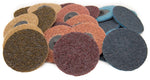
A unitized disc, also called a unitized wheel, is made from layers of nylon web loaded with abrasive grain, then compressed and bonded into one firm piece. It deburrs, blends welds, and finishes metal without the aggressive cut of a grinding wheel. The code sets how firm the disc is, which mineral does the cutting, and how fine the finish comes out.
Choosing by color, brand, or price alone can leave the wrong scratch pattern or round an edge you wanted to keep. This guide decodes the number, the letter, and the suffix. It also shows when a unitized wheel beats a standard non-woven disc or a flap disc, and where our stocked sizes fit.
How Do You Read a Unitized Disc Code?
Read every code in the same order: density number, mineral letter, grade suffix. The number is the density, from 2 (softest) to 9 (hardest). The letter is the mineral, and the suffix is the grade. So 2SF is a soft, silicon carbide, fine disc.
| Code Element | What It Means | What It Changes at the Workpiece | Example |
|
2 through 9 |
Density, from soft (low) to hard (high). Available ranges vary by product line. |
Low densities flex around contours. Higher densities hold their shape, keep an edge, and support firmer deburring. |
2 follows a tube. 8 works a defined edge. |
| S | Silicon carbide | A sharp, hard mineral that suits stainless steel and non-ferrous finishing and leaves a uniform finish. | 2SF (we stock 2S Fine) |
|
A |
Aluminum oxide | A general-purpose mineral for deburring and blending ferrous metals, including mild steel. | 6AM |
| F, M, C | Fine, medium, or coarse grade | Fine favors finish. Medium balances cut and finish. Coarse removes more material. | 8AC |
We stock 2SF today. The 6AM and 8AC examples are there to practice reading a code. A 2S Fine unitized disc is a low-density, silicon carbide, fine-grade option. A 6A unitized wheel is a denser aluminum oxide option, and a final M, as in 6AM, adds a medium grade.
Density is not grit. Two fine discs can leave different results, because stiffness changes how each one meets the part. Low density 2 and 3 discs conform around curves and irregular surfaces. Higher density 6 to 9 wheels resist deformation, hold an edge, and suit firmer blending and deburring.
Common Codes at a Glance
Use this table to see how the pattern scales from soft to hard. Only 2SF is on our shelf today. The other codes show how the number, letter, and suffix change the job.
| Code | Density Feel | Intended Task | Plain-Language Selection Cue |
| 2SF | Soft, highly conformable | Fine finishing on curves | Choose it when contour matters most. |
| 2AM | Soft, controlled | Blending irregular ferrous surfaces | Blend without cutting into contours. |
| 3SF | Conformable with support | Stainless and non-ferrous finishing | Choose it when density 2 feels too flexible. |
| 6SF | Firm, edge-retaining | Stainless blending and deburring | Best for flatter areas and defined profiles. |
| 6AM | Firm, general-purpose | Steel deburring and blending | An everyday choice for ferrous metal work. |
| 8AC | Hard, strong support |
Demanding deburring and edge work |
Use it when edge retention matters. |
Which Unitized Disc Density Fits Your Part?
Picture two parts at the same bench: a curved stainless tube and a square steel bracket with a heavy burr. The same disc can round the tube or leave the bracket edge half finished. Pick in this order: material, shape, then finish.
- Match the mineral to the material: Silicon carbide (S) is a practical starting point for stainless steel and non-ferrous metals. Aluminum oxide (A) is a general-purpose choice for mild steel and other ferrous metals.
- Match density to the shape: Density 2 and 3 conform to curves. Density 6 to 9 hold their shape on edges and flatter profiles.
- Match grade to the work: Coarse removes more material, medium blends, and fine refines the finish.
| Application | Practical Starting Code | Why It Fits |
|---|---|---|
|
Curved, irregular, or detail-sensitive parts |
2SF or 3SF | Conformability helps control the finish around contours. |
| General steel deburring and weld blending | 2AM or 6AM | Choose 2AM for finish control and 6AM when edge retention matters more. |
| Larger burrs or tougher edge breaking | 6AM or 8AC |
Denser construction supports firmer work. Test first, because it can change edges faster. |
Low Density (2 and 3): Soft Discs That Follow the Part
For a curved stainless tube, start with a low-density, fine silicon carbide disc. Our 2S Fine listings say it leaves a fine, uniform finish, particularly on stainless steel. Use light pressure. A soft disc finishes a surface rather than removing stock.
High Density (6 to 9): Firm Wheels That Hold an Edge
For a sharp edge that needs consistent blending, start higher. A harder wheel resists deforming under load, so it keeps the edge square while it works. Test on scrap first, because a firmer wheel can change an edge faster than you expect.
Which Unitized Discs and Wheels Do We Stock?
Here is what is on our shelf today. Use the density to choose, then match the format to your tool.
- 2 inch 2S Fine quick change discs, 5 pack: Type R attachment, 25,000 max RPM.
- 3 inch 2S Fine quick change discs, 5 pack: Type R attachment, 15,000 max RPM.
- 4-1/2 inch 2S Fine Type 27 disc: fiberglass backed, 7/8 inch center hole, 13,300 max RPM, for right angle grinders.
- 6 by 1 by 1 inch deburring wheels in 7SF, 8SF, and 9SF: 6,000 max RPM, for bench and pedestal grinders.
Every stocked code is silicon carbide in a fine grade, so density is the choice that changes your result. The 7SF, 8SF, and 9SF convolute deburring wheels wrap non-woven web around a solid core instead of bonding flat layers, but they read with the same code. We do not list an A-series wheel today, so a 6A unitized wheel is a reading example here, not a product.
Unitized Disc vs. Non-Woven Abrasive vs. Flap Disc
A non-woven disc is not automatically the better choice for finish work. Its flexible web follows contours well, but a compressed-density unitized disc gives you more control on crisp edges and small profiles.
| Abrasive Type | Best Use | Strength | When Not to Choose It |
|---|---|---|---|
| Unitized disc or wheel | Controlled deburring, blending, edge finishing, and detail work | Compressed construction supports consistent results | Heavy weld removal or major stock removal |
| Surface-conditioning non-woven abrasive | Broad cleanup, light blending, and conformable finishing | Flexible web follows curves and irregular surfaces | Preserving a defined edge or profile |
| Flap disc | Weld removal, shaping, beveling, and stock removal | Coated abrasive flaps cut aggressively | Light finishing where material removal must stay controlled |
Choose a unitized deburring disc when a controlled edge and a repeatable finish matter more than removing material fast. Its firm face supports smaller parts and defined profiles better than a standard surface-conditioning disc.
Choose a non-woven abrasive for broader cleanup or blending across curves. Our non-woven abrasives collection covers that family, so this guide stays with the compressed-density branch.
Choose a flap disc when the job still needs real grinding, such as reducing a weld bead or reshaping steel. Switch to a unitized disc afterward to refine the scratch pattern.
How Do You Match a Unitized Quick Change Disc to Your Tool?
Our 2 inch and 3 inch discs use a Type R quick change attachment, so you can swap a disc in seconds. The holder is sold separately and must match the disc. A 2 inch disc needs a 2 inch Type R holder with a 1/4 inch shank. The quick change disc collection lists the 2 inch and 3 inch mandrels alongside related discs.
Speed is the check that matters most. Your tool's free speed must never exceed the lowest maximum RPM marked on the disc, the holder, or the package. Our listings show 25,000 RPM for the 2 inch disc, 15,000 for the 3 inch, 13,300 for the 4-1/2 inch, and 6,000 for the convolute wheels.
Before you order, confirm these four things:
- The disc and holder share the same diameter.
- The attachment is Type R on both parts.
- Your tool takes the holder shank, or matches the format for the 4-1/2 inch and convolute sizes.
- Your tool's speed is at or below the lowest RPM rating among the disc, holder, and tool.
For a clean finish, use light to moderate pressure and keep the disc moving to avoid heat marks. Test on scrap or a hidden area before you finish a visible part.
Unitized Disc FAQs
What does 2SF mean on a unitized disc?
The 2 is the density, the softest on the scale. The S is silicon carbide, and the F is the fine grade. Together they describe a soft, conformable disc for controlled finishing on curves, small details, and parts where the shape must survive. Use light pressure and test on scrap when finishing visible stainless steel.
What is a 6A unitized wheel used for?
A 6A unitized wheel pairs a firm density 6 with aluminum oxide for general-purpose deburring and blending on ferrous metals. Its denser build gives more edge support than a density 2 wheel. Check the final suffix before you buy, since 6AM means medium grade. We do not stock an A-series wheel today.
Are unitized discs the same as non-woven surface-conditioning discs?
They are related, not identical. Both are non-woven abrasives, but unitized products compress and bond the layers into a firmer face for edge finishing and deburring. Standard surface-conditioning discs are more flexible and suit broad cleanup.
Can I use a unitized quick change disc on any die grinder?
No. The disc must match the holder style, the diameter, and your tool's speed. A disc that attaches is still unsafe if the grinder's free speed exceeds its rated maximum. Use the matching Type R holder, check the RPM, and replace damaged discs or holders before use.
Pick the Density First, Then the Format
A unitized disc code works as a buying guide. Density sets how well the disc follows a contour and holds an edge, the mineral suits the material, and the grade balances refining against removal. When the finish or contour is at risk, start softer and finer, then move to a denser or coarser wheel only when the burr demands it.
Shop 2S Fine unitized discs.
Join Our Newsletter
Sign up to get the latest on sales, new releases and more …Join Our Newsletter
Sign up to get the latest on sales, new releases and more …Shop Categories
Recent Articles
- How to Clean Root and Interpass Welds With a Stringer Bead Wheel
- How to Choose Spiral Bands by Size, Mineral, and Grit
- How to Read Unitized Disc Density Codes, 2S to 8A
- How to Choose the Right TCT Blade for Metal, Aluminum, and Wood
- How to Choose the Right Diamond Blade for Grinder
- Wire Wheels and Brushes: How to Choose the Right One
- How to Deburr Metal Safely and Efficiently
- How to Reduce Heat Discoloration When Grinding Stainless Steel
- How to Achieve a Mirror Finish on Stainless Steel
- A Fabricator’s Guide to Surface Prep Before Powder Coating
Featured Products
-
 746 Reviews
4-1/2" x 7/8" T29 Zirconia High Density Flap Disc - 10 pack
$25.19
-
 738 Reviews
4-1/2" x .040" x 7/8" t1 premium thin cut-off wheel - 25 pack
$20.88
-
 220 Reviews
4-1/2" x 7/8" T27 Zirconia High Density Flap Disc - 10 pack
$25.19
-
 380 Reviews
6" x .045 x 7/8" T1 Premium Thin Cut-Off Wheel - 25 pack
$27.29
-
 55 Reviews
Nonwoven 6" X 9" Scuff, Clean & Finish Hand Pads
$0.83
-
 123 Reviews
4-1/2" x 1/4" x 7/8" T27 Depressed Center Grinding Wheel - 25 pack
$28.34


Blog Categories
- Abrasives
- Sanding
- Grinding Deburring Finishing
- Safety and Cleanliness
- Metal Working
- Selecting Tools And Equipment
- Wood Working
- Art And Design
- Diy Projects
- Industry 4.0
- Buffing
- Cutting Tools
- Carbide Burrs
- PPE
- Wire Brushes
- Bonded Abrasives
- TIG Electrodes
- Wire Wheels
- Bits
- Diamond Blades
- Power Brushes
- Product Reviews
- Grinding
- Finishing
- Industrial Cleaners