



























How to Clean Root and Interpass Welds With a Stringer Bead Wheel

Slag and silicate hide at the toes of a root pass, and a wheel that rides up the bevel can scar the metal you need to fuse to. A stringer bead wheel exists to avoid both problems.
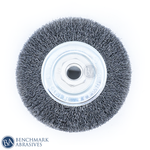
A stringer bead wheel is a wire wheel with a narrow face and knots twisted extra tight. That shape reaches the bottom of a groove, cleans a root pass or an interpass, and leaves the bevel width alone.
Here is how welders match the wheel to the root, hot, fill, and cap pass, why carbon steel and stainless wheels never mix, and how to size and run the wheel safely.
How a Stringer Bead Wheel Cleans a Narrow Groove
A standard knotted wheel has a wide face. In a narrow V-groove it touches both bevel walls at once, and it can ride up and take sidewall metal with it. A stringer bead wheel keeps the contact patch small. The cleaning force lands in the root, at the toes, and in inside corners, where the next pass needs a clean start.
The knots sit close together and are twisted extra narrow, so the wheel cuts with stiff, high-impact action. That clears slag, scale, and spatter between passes without widening the bevel or gouging base metal. Our wheels mount on a 5/8-11 arbor, so they spin onto an angle grinder.
Stringer Bead Wheel or Standard Twist Knot Wheel?
Pick by where the residue sits. A standard twist knot wire wheel covers open joints well, but the narrow groove is the stringer wheel's job.
- Stringer bead wheel: root passes, hot passes, narrow grooves, weld toes, and inside corners.
- Standard twist knot wheel: wider weld areas and general heavy cleanup where groove access matters less.
- Wider wheel: mill scale and broad surface cleanup, not root access.
Which Stringer Bead Wheel Setup Fits the Root, Hot, Fill, and Cap Pass?
The wheel you want after the root pass is not always the one you want at the cap. As the joint fills, the goal shifts from exposing a clean groove for fusion to protecting the cap profile and spotting defects instead of brushing over them. Follow the WPS and your shop procedure first.
| Weld stage | Primary cleaning goal | Preferred wheel/tool | Typical wheel configuration | Avoid/do not use when |
|---|---|---|---|---|
| Root pass | Remove slag, silicate islands, and loose deposits | Stringer bead wheel | Narrow face; tightly knotted wire; 0.020-inch wire, the gauge on every Benchmark stringer bead wheel | Cracking, suspected lack of fusion, or excessive penetration is present |
| Hot pass | Clean groove bottom and corners before fill passes | Stringer bead wheel | Narrow twist-knot wheel matched to groove width | Force is needed to remove embedded contamination |
| Fill/stringer passes | Expose slag lines and spatter between beads | Stringer bead wheel; small grinder or flap disc for repair only | Narrow wheel for cleaning | A wagon track, high spot, or defect needs correction |
| Cap pass | Remove loose residue without changing the profile | Light stringer-wheel use or hand brush, as allowed | Controlled pressure and limited contact | The cap needs visual acceptance inspection or cosmetic appearance must remain untouched |
| Tight-corner touch-up | Clean inside corners and toe areas | Narrow stringer wheel or small wire brush | Wheel sized for available access | The wheel contacts adjacent surfaces or cannot reach safely |
After the root pass, center the wheel in the groove, clear loose deposits, and look at both toes under good light before the hot pass. After the hot pass, clean the groove bottom and corners again. Do not lean on the wheel hard enough to bury contamination in the bead.
Between fill passes, brush just enough to show slag lines, trapped spatter, and debris. Go light at the cap. Hard brushing can change the profile or hide a condition an inspector should see.
After every pass, check for four things:
- No glassy slag line left in the groove.
- No trapped debris at either toe.
- No gouging in the bevel sidewalls.
- No defect hidden instead of repaired.
What a Stringer Bead Wheel Cannot Fix
A stringer bead wheel is an aggressive cleaning brush, not a repair tool. It removes slag, scale, and surface residue. It will not fix a wagon track, suspected lack of fusion, undercut, or a high spot.
When brushing exposes one of those, stop. Repair it the way your WPS requires, which often means grinding and then inspecting. Brushing over a defect only hides it from the next pass. For the other side of this topic, how a bead forms in the first place, read our guide to welding beads.
Why Carbon Steel and Stainless Wheels Must Stay Separate
We stock the stringer bead wheel in both carbon steel and stainless steel wire, and the choice is not cosmetic. Carbon steel wire can leave tiny iron particles on stainless. Add moisture and those particles rust. That shows up as stains and can weaken the passive surface that makes stainless resist corrosion.
ASTM A380, the practice for cleaning and passivating stainless steel parts, treats free iron picked up from tools as a corrosion concern. So a stainless wheel that has already cleaned carbon steel is now a carbon steel tool. Never send it back to a stainless job.
| Wheel fill | Suitable substrates | Contamination risk | Dedicated-tool rule | Storage/identification practice |
|---|---|---|---|---|
| Carbon steel fill | Carbon steel, structural steel, iron | High on stainless and non-ferrous metals | Use only for carbon steel cleanup | Mark “CS” and store separately |
| Stainless fill | Stainless steel; check guidance for aluminum and other non-ferrous work | Low when clean and dedicated | Never use on carbon steel | Mark “SS” and use a separate rack or bin |
| Stainless wheel previously used on carbon steel | Carbon steel only | High on stainless because iron may remain | Do not return it to stainless service | Relabel for carbon steel use |
Match the wire to the metal. Use a carbon steel stringer bead wheel on carbon steel. Use a stainless stringer bead wire wheel on stainless, and keep it off carbon steel. Our stainless listings also cover non-ferrous metals such as aluminum, so follow the workpiece maker's guidance there.
Mark each wheel CS or SS, and store stainless wheels away from carbon steel brushes. On critical stainless work, give the wheel its own grinder too. Our guide to carbon steel vs. stainless steel wire wheels covers the selection side in more detail.
Stainless wheels cost more than carbon steel wheels. That gap is small next to rework, rust staining, or a failed inspection.
How to Choose Stringer Bead Wheel Size and Wire Fill
Start from the joint, not the catalog. If the area is open and you only need broad cleanup on carbon steel, our steel wire wheels are the better fit. In a narrow groove, stay with the stringer bead style.
We stock stringer bead wheels in five diameters: 4, 4-1/2, 5, 6, and 7 inch. Each comes in carbon steel and stainless steel, with a 5/8-11 arbor and 0.020 inch wire. The wire fill is the same across the range, so your real choices are diameter and material.
- Diameter: A 4 inch wheel is rated to 20,000 RPM and fits tight bevels and limited access. The 4-1/2, 5, and 6 inch wheels are rated to 12,500 RPM. The 7 inch wheel is rated to 9,000 RPM.
- Wire fill: Every wheel we stock uses 0.020 inch wire. It cuts hard, so it needs light pressure and enough joint clearance.
- Material: Carbon steel wire for carbon steel work, stainless wire for stainless work.
- Grinder match: The stamped max RPM must meet or exceed your grinder's no-load speed, and the wheel must fit the guard.
Before you mount a wheel, confirm the stamped max RPM, the diameter, the 5/8-11 arbor thread, the wire material, and the grinder's no-load speed.
Match the wheel to the grinder, never the other way around. Compare sizes and materials in our stringer bead wheels collection.
How to Clean a Weld Pass Without Overworking the Wheel
Does pressing harder clean faster? No. Heavy pressure flexes and fatigues the wire, can peen debris into the weld, and makes the wheel shed wire early. Run this sequence on every pass:
- Inspect before mounting. Check for bent, missing, or loose wire. Confirm the stamped max RPM is at least your grinder's no-load speed, and keep the guard on.
- Gear up. Wear safety glasses under a full face shield, gloves, long sleeves, and hearing protection. Add a respirator suited to the work.
- Reach full speed before contact. Line the wheel up with the groove centerline, then touch down.
- Sweep or pull with steady, moderate pressure. Tip the wheel only slightly to reach each toe. Do not dig into one bevel edge.
- Stop and inspect under good light. Brush off loose residue, and repair slag inclusions, undercut, or other defects by the WPS method instead of brushing over them.
Heavy wire shedding can point to overspeed, hard pressure, a damaged wheel, sharp edges, hard inclusions, or end-of-life wear. Replace a damaged wheel right away. Follow the wheel, grinder, and worksite safety instructions, and keep every guard in place.
Stringer Bead Wheel FAQs
What is the difference between a stringer bead wheel and a standard knot wire wheel?
A stringer bead wheel has a narrow face and tightly twisted knots that focus cleaning force inside a weld joint. A standard knot wheel has a broader contact area for general scale, rust, and weld cleanup. Choose the stringer wheel for root passes, hot passes, narrow bevels, toes, and inside corners. Use the broader wheel when access is open.
Can I use a carbon steel stringer bead wheel on stainless steel?
No. Carbon steel wire can leave free iron on stainless, which may rust and stain the surface or reduce its corrosion resistance. A stainless wheel that has touched carbon steel is no longer a stainless tool, so keep stainless wheels labeled and separate.
Why is my stringer bead brush shedding wire so fast?
Common causes are too much pressure, running above the stamped max RPM, a damaged wheel, or a poor contact angle. Some shedding is normal as a wheel wears. Loose wire, bent knots, or heavy vibration mean it is time to replace the wheel. Let the wheel do the cleaning, and keep the guard, safety glasses, and face shield on.
What size stringer bead wire wheel should I use for root pass cleaning?
On most right-angle grinders, start with a 4 inch or 4-1/2 inch wheel. Both have a 5/8-11 arbor and 0.020 inch wire, and the 4 inch wheel gives the most access. The right pick still depends on groove width, clearance, and a max RPM rating that meets or exceeds your grinder's no-load speed.
Pick the Right Stringer Bead Wheel Before the Next Pass
Start with the pass, not the wheel. A stringer bead wheel is the right tool for cleaning root, hot, and fill passes inside a narrow groove, where a wider wire wheel would touch the bevel walls.
Then check three things: the wire material against the base metal, the wheel size against your access, and the stamped RPM against your grinder. Clean each pass until leftover slag, undercut, or a fusion concern is visible, and follow your repair procedure if the wheel exposes a defect.
Shop our carbon steel and stainless stringer bead wheels.
Join Our Newsletter
Sign up to get the latest on sales, new releases and more …Join Our Newsletter
Sign up to get the latest on sales, new releases and more …Shop Categories
Recent Articles
- How to Clean Root and Interpass Welds With a Stringer Bead Wheel
- How to Choose Spiral Bands by Size, Mineral, and Grit
- How to Read Unitized Disc Density Codes, 2S to 8A
- How to Choose the Right TCT Blade for Metal, Aluminum, and Wood
- How to Choose the Right Diamond Blade for Grinder
- Wire Wheels and Brushes: How to Choose the Right One
- How to Deburr Metal Safely and Efficiently
- How to Reduce Heat Discoloration When Grinding Stainless Steel
- How to Achieve a Mirror Finish on Stainless Steel
- A Fabricator’s Guide to Surface Prep Before Powder Coating
Featured Products
-
 746 Reviews
4-1/2" x 7/8" T29 Zirconia High Density Flap Disc - 10 pack
$25.19
-
 738 Reviews
4-1/2" x .040" x 7/8" t1 premium thin cut-off wheel - 25 pack
$20.88
-
 220 Reviews
4-1/2" x 7/8" T27 Zirconia High Density Flap Disc - 10 pack
$25.19
-
 380 Reviews
6" x .045 x 7/8" T1 Premium Thin Cut-Off Wheel - 25 pack
$27.29
-
 55 Reviews
Nonwoven 6" X 9" Scuff, Clean & Finish Hand Pads
$0.83
-
 123 Reviews
4-1/2" x 1/4" x 7/8" T27 Depressed Center Grinding Wheel - 25 pack
$28.34


Blog Categories
- Abrasives
- Sanding
- Grinding Deburring Finishing
- Safety and Cleanliness
- Metal Working
- Selecting Tools And Equipment
- Wood Working
- Art And Design
- Diy Projects
- Industry 4.0
- Buffing
- Cutting Tools
- Carbide Burrs
- PPE
- Wire Brushes
- Bonded Abrasives
- TIG Electrodes
- Wire Wheels
- Bits
- Diamond Blades
- Power Brushes
- Product Reviews
- Grinding
- Finishing
- Industrial Cleaners