



























Square Insert Bits vs Standard Driver Bits Explained

In the world of high-stakes fastening, whether you're framing a deck, building custom cabinetry, or assembling industrial machinery, your tool's 'bite' is everything. If you’ve ever felt that sickening "skip" as a bit rounds out a screw head, you’ve experienced a fundamental failure in the screw drive system.
When comparing square insert bits to standard driver bits, the debate typically centers on one key aspect: reliability under pressure.
Choosing the right screwdriver bits isn't just about what's in your pocket; it’s about torque transfer, bit life, and preventing the dreaded fastener damage that turns a five-minute task into a two-hour extraction nightmare.
This guide dives deep into the drive systems that power modern construction to help you decide which bit suits your drill.
Which Drill Bit Works Better Under Load?
The fundamental purpose of any drive system is to bridge the gap between your power tool and the fastener. However, not all bridges are built to carry the same weight. Square insert bits and standard driver bits represent two different philosophies of engineering.
Standard bits, particularly the ubiquitous Phillips design, were originally designed with a "fail-safe" in mind, to pop out when the torque got too high.
Square bits, conversely, were built to stay engaged until the screw breaks or the motor stalls.
This difference affects every aspect of your work, from how much physical pressure you need to apply to the drill to how many screws you can drive before needing a new bit. In high-torque applications, the square drive is almost always the superior choice, providing the grip needed for heavy use without slipping.
At Benchmark Abrasives, we prioritize bits that maximize this engagement, ensuring that your tools work with you, not against you.
Screw Drive Systems and Why They Matter
A screw drive system is the mechanical interface between the driver tip and the fastener head. Its efficiency is determined by contact points and surface area.
In a perfect world, 100% of the energy from your motor would transfer into the rotation of the screw. In reality, much of that energy is lost to friction, heat, and "cam out" (the bit slipping out of the head).
There are several common types of drive systems used today:
- Slotted (Flat Head): The oldest and least efficient, with only two points of contact.
- Phillips: Designed to "cam out" to prevent over-tightening in early factory assembly lines.
- Square (Robertson): A four-sided taper that provides deep engagement and massive torque.
- Hex/Torx: Advanced systems that use six or more points of contact to maximize torque.
Understanding these systems is vital because using the wrong drive type for a specific material, like driving long screws into dense pressure-treated lumber, can lead to total project failure.
What are Square Insert Bits?
Square insert bits (often called Robertson bits) feature a square-shaped driver tip that fits into a matching square recess in the fastener head.
One of the main advantages of the square drive is its tapered design. As you push the square driver into the screw, the taper creates a "friction fit." In many cases, you can put a screw on the end of the bit, and it will stay there even if you turn the drill upside down, no magnets required.
Historically, these screw bits became the standard in construction and high-end woodworking because they allow one-handed operation and deliver high torque without stripping the head.
What are Standard Driver Bits?
In the United States and much of Europe, standard bits usually refer to the Phillips screw and the flat head. These are the bits you find in almost every basic bit set at a hardware store.
The Phillips design is characterized by a cross shape. While it revolutionized the automotive industry in the 1930s, it has a fatal flaw for modern high-rated power tools: it is designed to slip. As the screw reaches a certain level of resistance, the angled flanks of the Phillips bit force it up and out of the screw.
Hex drives and other standard bits found in bit sets were developed to offer better grip than the flat head, but they still struggle to match the sheer "locking" feel of a square insert bit.
Design Differences: Geometry, Contact, and Engagement
The difference between square and standard bits is visible in their cross-section.
- Standard Phillips: The driver tip is pointed with four flared wings. The contact points are thin lines along the edges of those wings. This provides a limited surface area for torque.
- Square Insert: The cross-section is a solid square. When inserted, the four flat faces of the bit press against the four flat walls of the screw head. This distributes the force across a much larger area.
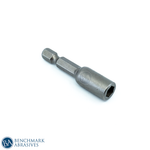
Furthermore, most pro-grade bits today feature a hex shank (usually 1/4 inch). This hex shank design prevents the bit from slipping inside the keyless chuck of your drill. When you combine a high-quality hex shank with a solid square drive tip, you get a tool string that is incredibly stable under load.
Cam-Out Resistance: Where Square Insert Bits Excel
In the world of screwdriving, "cam out" is the enemy. It happens when the torque required to turn the screw exceeds the bit's ability to stay in the hole.
The Phillips screwdriver is the king of cam-out. Because the walls of a Phillips screw are angled, the bit naturally wants to climb out as you apply torque. This results in a "clicking" sound as the bit grinds against the screw head, which ruins both the screw and the bit.
Square insert bits virtually eliminate this.
Because the walls of the square recess are nearly vertical, there is no upward force generated during rotation. You don't have to lean your entire body weight against the drill to keep the bit engaged. This makes high-torque applications much safer and less tiring for the operator.
Torque Handling and Heavy-Duty Fastening Performance
When your project moves from "assembling a bookshelf" to "building a pole barn," higher torque becomes a necessity.
In high-torque applications, standard bits will often snap or round off. Square bits, especially those made from high-grade tool steel, can handle the massive rotational force of modern 18V and 20V power tools.
For the best results, you should look for impact-rated bits. These bits feature a "torsion zone"—a slimmed-down portion of the bit-shanks that allows the bit to flex slightly under the hammer-blow of an impact driver, preventing the tip from shattering.
Safety Warning: Always verify that your bits are "Impact Rated" before using them with an impact driver or impact wrench. Standard bits made from brittle steel can shatter under the rapid concussive force, creating dangerous metal shards.
Bit Life and Wear Over Time
How long a bit lasts depends on the quality of the engagement. Because Phillips bits slip frequently, they wear out fast. Each "slip" rounds off the sharp edges of the wings.
Square bits tend to have a much longer bit life. Since they don't slip, the edges stay crisp.
At Benchmark Abrasives, we recommend looking for bits with black oxide coatings. These treatments provide good corrosion resistance and help the bit "grip" the fastener metal.
A new bit should feel tight in the screw head; if there is "wiggle," it's time to swap it out before you strip a fastener.
Performance with Power Tools
Your bit choice must match your tool.
- Power Drill/Drill Driver: Good for both, but the keyless chuck must be tightened properly onto the hex shank.
- Impact Drill/Impact Driver: This is where the square bit shines. An impact drill uses rapid internal strikes to turn the screw. Impact driver bits with a square head can take those hits and transfer them directly to the screw without bouncing out.
- Power Screwdriver: For low-torque work, standard bits are fine, but for construction work, prefer square.
Fastener Types and Materials
Square insert bits are the best tool for:
- Long Screws: 3-inch to 6-inch deck screws require massive torque that would strip a Phillips head instantly.
- Stainless Steel: Stainless is a "soft" metal that strips easily. The deep engagement of a square drive protects the stainless steel fastener.
- Sheet Metal: Self-tapping screws for sheet metal often use square drives because they need to be held steadily while the tip pierces the metal.
- Set Screws: Used in machinery where the screw must be flush or recessed.
Always ensure you have the right bit for the screw size. Square bits typically come in various sizes. Using the right bit in a screw will lead to an immediate strip-out.
Bit Sizes, Lengths, and Configurations
Square insert bits come in different sizes and bit lengths to suit the job:
- 1-inch Insert Bits: These are intended for use with a magnetic bit holder. They are economical and easy to swap in and out of a tool kit.
- 2-inch to 6-inch Power Bits: These have the hex shank built directly onto the bit. Long bits are essential for reaching into tight spaces or recessed pockets in cabinetry.
- Double-Ended Bits: These offer two sizes on a single bit, providing versatility in a single tool set.
Holding and Retention Systems
To improve your workflow, consider how the bit stays in the tool.
- Magnetic Bit Holder: Essential for standard bits and 1-inch inserts. A strong magnet holds the screw to the bit, which is vital for overhead work.
- Ball Detent: Many hex shank bits have a small notch that allows them to lock into an impact driver for a quick-release mechanism.
- Keyless Chuck: Most modern power drills use these. While convenient, they can sometimes loosen under high vibration, so give them an extra twist before starting a heavy drive.
Square Insert Bits vs Torx, Hex, and Other Drives
While we are focusing on Square vs. Standard, we must know the competition.
- Torx Bits (Star Drive): These are currently the "gold standard" in premium construction. They offer even better torque than square bits but are more expensive.
- Hex Bits: Used largely in furniture (IKEA style) and machinery. They use an Allen key or hex bit. They are great, but can strip if the bit sizes aren't a perfect match.
- Square Drive: Remains the best middle-ground for cost and performance. It is much harder to strip than a Phillips and more affordable/available than Torx in many regions.
When to Choose Square Insert Bits?
- Construction Work: Any project requiring repeatable, high-torque fastening (decks, framing, fences).
- Drilling Holes and Pilot Holes: When you are driving into pilot hole scenarios, where the wood is dense and the resistance is high.
- Home Improvement: For any project where you want to avoid the frustration of stripped screws.
When to Choose Standard Driver Bits?
- Light-Duty Fastening: Simple furniture assembly or low-torque household repairs.
- Wide Availability: If you are in a pinch and need a fastener from a corner store, Phillips is still the most common.
- Hand Tools: When using hand tools or individual drivers, the cam-out of a Phillips bit can actually act as a safety to prevent you from over-torquing by hand.
Selecting the Right Bit for Your Job
| Task | Recommended Drive | Why? |
| Hanging Drywall | Phillips | Designed to “cam out” so you don't tear the paper. |
| Deck Building | Square / Torx | Needs higher torque for long screws in treated wood. |
| Cabinetry | Square | Allows for one-handed reach in tight spaces. |
| Automotive Prep | Hex / Torx | Precision is required for high-vibration environments. |
The main advantages of the square bit—stability and cam-out resistance—make it the clear winner for heavy-duty home improvement and construction work.
Square Insert Bits in Professional Tool Kits
Every professional tool kit or tool set should have a dedicated section for power tool accessories. When building your tool set, don't just rely on the cheap bits that come free with the drill. Look for brand names that specify "Impact Rated" and "S2 Tool Steel." At Benchmark Abrasives, we focus on providing these high-performance components because we know that a $0.50 bit can either save or ruin a $5,000 project.
Built for Torque, Control, and Long-Term Performance
In the battle of square insert bits vs standard driver bits, the square drive wins on almost every performance metric. It handles higher torque, resists cam-out, and extends bit life. While standard bits like the Phillips still have their place in light-duty applications and drywall, the square insert bit is the backbone of heavy-duty fastening.
By matching the right bit to your torque settings and fastener material, you ensure cleaner results and less frustration.
Are you ready to enhance your drive? Explore our collection of high-rated square insert bits and professional power tool accessories at Benchmark Abrasives. Whether you’re handling a massive home improvement project or a professional construction work contract, we have the right design to handle the pressure. Explore our collection today.
Join Our Newsletter
Sign up to get the latest on sales, new releases and more …Join Our Newsletter
Sign up to get the latest on sales, new releases and more …Shop Categories
Recent Articles
- Resin Fiber Discs vs Flap Discs: When Should You Use Each?
- Best Abrasives for Rust Removal on Steel
- Cut-Off Wheels vs Band Saws: Which is Better for Metal Cutting
- How to Optimize RPM Abrasive Disc Performance & Lifespan
- Surface Conditioning Discs: A Fabricator's Guide
- Best Flap Disc for Stainless Steel: Complete Fabricator’s Guide
- Ceramic vs Zirconia Flap Discs: Which Performs Better for Metal Fabrication
- How to Choose the Right Grit for Metal Sanding Projects
- Tools Collection for Fabrication and Abrasive Workflows
- How to Choose the Right Diamond Blade
Featured Products
-
 746 Reviews
4-1/2" x 7/8" T29 Zirconia High Density Flap Disc - 10 pack
$25.19
-
 738 Reviews
4-1/2" x .040" x 7/8" t1 premium thin cut-off wheel - 25 pack
$20.88
-
 220 Reviews
4-1/2" x 7/8" T27 Zirconia High Density Flap Disc - 10 pack
$25.19
-
 380 Reviews
6" x .045 x 7/8" T1 Premium Thin Cut-Off Wheel - 25 pack
$27.29
-
 55 Reviews
Nonwoven 6" X 9" Scuff, Clean & Finish Hand Pads
$0.83
-
 123 Reviews
4-1/2" x 1/4" x 7/8" T27 Depressed Center Grinding Wheel - 25 pack
$28.34


Blog Categories
- Abrasives
- Sanding
- Grinding Deburring Finishing
- Safety and Cleanliness
- Metal Working
- Selecting Tools And Equipment
- Wood Working
- Art And Design
- Diy Projects
- Industry 4.0
- Buffing
- Cutting Tools
- Carbide Burrs
- PPE
- Wire Brushes
- Bonded Abrasives
- TIG Electrodes
- Wire Wheels
- Bits
- Diamond Blades
- Power Brushes
- Product Reviews
- Grinding
- Finishing
- Industrial Cleaners