









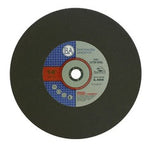





















Cut-Off Wheel Size and Thickness Chart (.040 vs .045 vs 1/16 vs 1/8)

This cutting wheel size chart matches cut-off wheels to your tool by diameter, thickness, arbor and max RPM. A size reads diameter x thickness x arbor, such as 4-1/2 x .040 x 7/8. Choose the diameter your guard allows, the arbor your spindle or mandrel takes, and a thickness that suits the cut. Then confirm the wheel's max RPM is at or above your tool's speed.
Key Takeaways
- A wheel size reads diameter x thickness x arbor. Max RPM is marked on the wheel and listed on its product page.
- Thin wheels (.040 and 1/32 inch) cut the narrowest kerf. Thicker wheels (1/16, 5/64 and 1/8 inch) hold a straighter line.
- Match the arbor to your spindle or mandrel: 3/8, 5/8 or 7/8 inch. A 5/8-11 hub is threaded, and a 7/8 inch arbor is not.
- Max RPM falls as diameter grows: 25,000 RPM on 2 and 3 inch wheels, 8,600 to 8,700 RPM on 7 and 9 inch wheels.
- Tool speed must never exceed the wheel's max RPM. When a mandrel is involved, the lower rating sets the limit.
How do you read cut-off wheel sizes?
Every cut-off wheel size follows the same order: diameter, thickness, arbor. A 4-1/2 x .040 x 7/8 wheel is 4-1/2 inches across and .040 inch thick, with a 7/8 inch center hole. That center hole is the arbor, or the threaded hub on wheels that spin onto the spindle.
Cut-off wheel thickness appears as a decimal or a fraction, so use this translation:
- .040 inch is about 1 mm
- 1/32 inch is .031 inch
- 1/16 inch is .0625 inch
- 5/64 inch is .078 inch
- 1/8 inch is .125 inch
By the numbers, 1/16 inch is thicker than .045, and 1/8 inch is twice as thick as 1/16 inch.
Two more marks matter. Type tells you the wheel shape, and max RPM is the fastest speed the wheel is rated to spin. Every wheel in the chart below is a Type 1 flat wheel that cuts on its edge. To see how Type 1 compares with depressed center wheels, read our Type 1 vs Type 27 guide.
What is the cutting wheel size chart for Benchmark cut-off wheels?
This chart lists every wheel in our cut-off category, using the specification block on each product page. Rows run from 2 inch die grinder wheels up to 9 inch angle grinder wheels. Grain appears only as a short note: AO is aluminum oxide, AO + SiC adds silicon carbide for the aluminum line, and ceramic marks the 4X line.
| Wheel (diameter x thickness x arbor, Type) | What it fits / does | Max RPM (product page) |
|---|---|---|
| 2 x 1/32 x 3/8, Type 1 | Ultra-thin wheel for small cuts in tight spaces on a die grinder with the mandrel. AO | 25,000 |
| 2 x 1/16 x 3/8, Type 1 | Small parts, tubing and fasteners in tight spaces. Die grinder with the mandrel. AO | 25,000 |
| 3 x .040 x 3/8, Type 1 | Narrow cut with more reach than a 2 inch wheel. Die grinder with the mandrel, or a 3 inch cut-off tool. AO | 25,000 |
| 3 x 1/16 x 3/8, Type 1 | General thin cuts with extra reach. Die grinder with the mandrel, or a 3 inch cut-off tool. AO | 25,000 |
| 3 x 1/8 x 3/8, Type 1 | Heavier cuts where a thicker wheel gives more support. Die grinder with the mandrel, or a 3 inch cut-off tool. AO | 25,000 |
| 4 x .040 x 5/8, Type 1 | Narrow cuts on a 4 inch angle grinder with the 4 inch cut-off guard and 5/8 inch flanges. AO | 15,300 |
| 4 x 1/16 x 3/8, Type 1 | Tubing, pipe and sheet with more reach. Guarded 4 inch cut-off tool, or a die grinder with the mandrel. AO | 22,000 |
| 4-1/2 x .040 x 7/8, Type 1 (premium) | Narrow kerf on a 4-1/2 inch angle grinder with a Type 1 cut-off guard. AO | Under review. Read the label on the wheel |
| 4-1/2 x .040 x 7/8, Type 1 (aluminum) | Aluminum and approved nonferrous metals, edge cutting only. AO + SiC | 13,500 |
| 4-1/2 x .040 x 7/8, Type 1 (4X ceramic) | Production cutting on a 4-1/2 inch angle grinder. Ceramic | 13,500 |
| 5 x .045 x 7/8, Type 1 (premium) | Added reach on 5 inch grinders rated for 5 inch wheels. AO | 12,225 |
| 5 x .045 x 7/8, Type 1 (aluminum) | Aluminum and approved nonferrous metals on 5 inch grinders. AO + SiC | 12,225 |
| 5 x .040 x 7/8, Type 1 (4X ceramic) | Demanding 5 inch cutting. Not for a grinder rated above 10,200 RPM. Ceramic | 10,200 |
| 6 x .045 x 7/8, Type 1 (premium) | Reach for larger tubing, pipe and structural parts on 6 inch grinders. AO | 10,200 |
| 6 x .045 x 7/8, Type 1 (aluminum) | Larger aluminum tubing, extrusions and sheet. AO + SiC | 10,200 |
| 6 x .040 x 7/8, Type 1 (4X ceramic) | Heavier fabrication and production cutting on 6 inch grinders. Ceramic | 13,500 |
| 7 x .045 x 7/8, Type 1 (premium) | Larger tubing, pipe and structural parts on 7 inch grinders. AO | 8,600 |
| 7 x .045 x 7/8, Type 1 (aluminum) | Larger aluminum tubing, extrusions and sheet. AO + SiC | 8,600 |
| 7 x 1/8 x 5/8, Type 1 (diamond knockout) | More body for heavy cuts on 7 inch machines that accept a diamond knockout arbor. AO | 8,700 |
| 9 x 5/64 x 7/8, Type 1 | Large tubing, pipe and structural cuts on 9 inch grinders. AO | 8,700 |
Read the last column before you buy. If your tool runs faster than the number shown, choose a different wheel. The 4-1/2 x .040 x 7/8 premium wheel shows no figure because its rating is under review, so read the label on the wheel itself for that one.
Shop the Benchmark cut-off wheel collection.
Which thickness should you choose: .040, .045, 1/16 or 1/8 inch?
Thickness trades kerf against stability. A thinner wheel removes less material and cuts a narrower slot, but it tolerates less side load. A thicker wheel holds a straighter line and has more body, but it cuts a wider kerf.
The gap between .040 and .045 is only .005 inch, so treat it as a tie-breaker rather than a big performance change. Material comes first, so read our guide to choosing a wheel by cutting material, then use this table to set thickness.
| Thickness | What it does (kerf, stability) | When to choose it |
|---|---|---|
| 1/32 inch (.031) | Narrowest kerf in the chart and the least material removed. Lowest side-load tolerance. | Thin stock and small slots on a die grinder, where you can hold the wheel straight. |
| .040 inch (about 1 mm) | Narrow kerf with minimal material removal. Low side-load tolerance. | Sheet, tubing and fasteners when control and low waste matter. Found on 3 to 6 inch wheels. |
| .045 inch | Narrow kerf with a little more stiffness than .040. | Everyday cutting on 5, 6 and 7 inch grinders. |
| 1/16 inch (.0625) | More wheel body than .045, with a wider kerf. | General cuts on 2 to 4 inch wheels when you want steadier cutting. |
| 5/64 inch (.078) | Thicker than 1/16 inch, yet still a thin wheel for its 9 inch size. | Large tubing, pipe and structural cuts on a 9 inch grinder. |
| 1/8 inch (.125) | Thickest wheel in the chart, with the widest kerf and the most support. |
Heavier cuts, such as the 3 inch die grinder wheel and the 7 inch wheel. |
.040 inch and 1/32 inch ultra-thin wheels
Ultra-thin cut-off wheels cut the narrowest kerf and remove the least material. They suit sheet metal, tubing and fasteners where control matters. They also tolerate the least side load, so keep the wheel straight in the cut. The 2 x 1/32 x 3/8 wheel is the thinnest we stock, and the 4-1/2 x .040 x 7/8 wheel brings a thin kerf to one of the most common angle grinder sizes.
.045 inch thin wheels
A .045 wheel is the everyday thin option on 5 to 7 inch grinders. It keeps the kerf narrow while adding a little stiffness over .040. We offer .045 in 5, 6 and 7 inch sizes, in standard and aluminum versions, so you can stay with one thickness as the diameter changes.
1/16 inch and 5/64 inch wheels
These wheels add body for steadier cutting. The 2, 3 and 4 inch die grinder wheels come in 1/16 inch, and the 9 inch wheel is 5/64 inch. You give up some kerf width, because a thicker wheel removes more material through the cut.
1/8 inch wheels
The 1/8 inch wheel is the thickest in the chart and gives the most support on heavier cuts. We stock a 3 x 1/8 x 3/8 wheel for die grinders and a 7 x 1/8 x 5/8 wheel with a diamond knockout arbor. Like every wheel here, they are for cutting only, so never grind with the side.
What size cut-off wheel fits your tool?
Start with the tool and its guard. The guard sets the largest wheel you can mount, and the tool's speed must stay at or below the wheel's max RPM. Then match the arbor. Example grinders in the table come from our product pages.
| Tool | Wheel diameter + arbor | Max RPM rule |
|---|---|---|
| Straight die grinder (1/4 inch collet) with the BM-M38_1 mandrel | 2 and 3 inch wheels with a 3/8 inch arbor, plus the 4 x 1/16 x 3/8 wheel | The lower of the mandrel's 25,000 RPM and the wheel's max sets the limit. Tool speed must stay at or below it. |
| Guarded 3 to 4 inch cut-off tool | 3 inch wheels with a 3/8 inch arbor, or the 4 x 1/16 x 3/8 wheel on a 4 inch guard | Tool speed at or below the wheel's max: 25,000 RPM for 3 inch wheels, 22,000 RPM for the 4 inch wheel. |
| 4 inch angle grinder | 4 x .040 x 5/8, with the 4 inch cut-off guard and 5/8 inch flanges | 15,300 RPM max. The grinder named on the product page runs 11,000 RPM. |
| 4-1/2 inch angle grinder | 4-1/2 inch wheels with a 7/8 inch arbor | Tool no-load RPM at or below the wheel's max. Grinders named on the product pages run 10,000 to 11,500 RPM. |
| 5 inch angle grinder rated for 5 inch wheels | 5 inch wheels with a 7/8 inch arbor | Tool no-load RPM at or below the wheel's max, which is 10,200 to 12,225 RPM by line. |
| 6 inch angle grinder rated for 6 inch wheels | 6 inch wheels with a 7/8 inch arbor | Max is 10,200 to 13,500 RPM by line. Grinders named on the product pages run 9,000 to 10,000 RPM. |
| 7 inch angle grinder rated for 7 inch wheels | 7 x .045 x 7/8, or 7 x 1/8 x 5/8 with a diamond knockout | Max is 8,600 to 8,700 RPM. Grinders named on the product pages run 6,600 to 8,500 RPM. |
| 9 inch angle grinder rated for 9 inch wheels | 9 x 5/64 x 7/8 | 8,700 RPM max. The grinders named on the product page run 6,600 RPM. |
A wheel that fits the arbor is not automatically safe on a tool. Our 5 inch pages say not to mount a 5 inch wheel on a grinder limited to 4-1/2 inch wheels just because the arbor fits. For tool fit, technique and troubleshooting, read our angle grinder cut-off wheel guide.
What arbor size do you need?
Cut-off wheel arbor size comes down to the center hole. It has to match the spindle, flange set or mandrel head exactly. A 7/8 inch arbor is a plain hole that clamps between two flanges. A 5/8-11 hub is threaded, with a 5/8 inch diameter and 11 threads per inch, and it spins onto a matching spindle. The two are not interchangeable without an approved mounting setup.
| Arbor / hub | What it mounts on | What to check |
|---|---|---|
| 1/4 inch shank | A die grinder collet, as the shank of the BM-M38_1 mandrel | The collet matches the shank, and the mandrel is rated 25,000 RPM. |
| 1/4 inch arbor | The mandrel's 1/4 inch head, for wheels with a 1/4 inch center hole | Use the head that matches the wheel's arbor exactly. |
| 3/8 inch arbor | The mandrel's 3/8 inch head, or a 3 to 4 inch cut-off tool with 3/8 inch hardware | Used by the 2 and 3 inch wheels and the 4 x 1/16 x 3/8 wheel. Match head and wheel exactly. |
| 5/8 inch arbor | 4 inch angle grinders with 5/8 inch flanges | Use the 4 inch cut-off guard and the flanges made for a 5/8 inch arbor. |
| 5/8 inch with diamond knockout | 7 inch machines that accept the round or diamond drive | The machine must be approved for 7 inch bonded wheels with this arbor. A matching arbor alone is not enough. |
| 7/8 inch arbor | 4-1/2 to 9 inch angle grinders, clamped between inner and outer flanges | Flanges and guard must suit the wheel diameter and the tool. |
| 5/8-11 threaded hub | Angle grinder spindles with a 5/8-11 thread, spin on and spin off | Confirm the spindle thread. A wheel with a 7/8 inch arbor will not screw onto it. |
Small wheels use the BM-M38_1 mandrel. Its 1/4 inch shank fits a die grinder collet, and its 3/8 inch and 1/4 inch heads match wheels with those arbors. Never run the setup faster than the lower of the mandrel's 25,000 RPM and the wheel's max RPM.
None of the wheels in the chart use a 5/8-11 hub, so check the spindle thread before choosing a spin-on style.
Why does max RPM drop as wheel diameter goes up?
Rim speed explains it. At the same RPM, the edge of a larger wheel travels farther with every turn, so it moves faster. Larger wheels carry lower speed ratings to keep that edge speed in check.
Our pages show the pattern. The 2 and 3 inch wheels rate 25,000 RPM. The 4-1/2 inch aluminum and 4X wheels rate 13,500, the 5 inch wheels 10,200 to 12,225, the 6 inch wheels 10,200 to 13,500, the 7 inch wheels 8,600 to 8,700 and the 9 inch wheel 8,700. It is a trend, not a rule. The 6 inch 4X ceramic wheel rates higher than the 5 inch 4X ceramic wheel, so read each page.
Compare the wheel's number with the no-load RPM on your tool's nameplate. For more on reading speed markings, see our guide to RPM ratings on abrasive tools.
OSHA states the same rule for abrasive wheel machinery. Under 29 CFR 1910.215(d)(1), spindle speed must not exceed the maximum operating speed marked on the wheel.
What do people ask about cut-off wheel sizes?
What is the most common cut-off wheel size?
The 4-1/2 inch wheel is the size most people reach for, and our product pages call it one of the most common angle grinder sizes. In our chart it is a .040 wheel with a 7/8 inch arbor. Check your guard, arbor and tool speed before you buy.
Is a .040 cut-off wheel better than .045?
Neither is better across the board. A .040 wheel cuts a slightly narrower kerf and removes less material. A .045 wheel is a little stiffer. The gap is only .005 inch, so pick the one that matches the control you need on the cut.
Can I put a 5 inch cut-off wheel on a 4-1/2 inch grinder?
Not unless the grinder maker approves it. A matching arbor does not make the fit safe, because the guard, wheel capacity and speed must all allow it. Our 5 inch product pages say not to mount the wheel on a grinder limited to 4-1/2 inch wheels, with dual-capacity grinders as the exception when the maker approves the guard.
What arbor size is a 4-1/2 inch cut-off wheel?
Every 4-1/2 inch wheel in our chart has a 7/8 inch arbor, which clamps between the grinder's flanges. Some other wheel styles use a 5/8-11 threaded hub that spins onto the spindle instead. Check which one your grinder takes before you buy.
What size cut-off wheel fits a die grinder?
Our 2 and 3 inch wheels fit a straight die grinder through the BM-M38_1 mandrel, which takes wheels with a 3/8 inch arbor and runs up to 25,000 RPM. The 4 x 1/16 x 3/8 wheel also fits that setup, but it is rated 22,000 RPM, so check your grinder's speed first.
How thick is a 1/16 cut-off wheel in decimals?
A 1/16 inch wheel is .0625 inch thick. That makes it thicker than a .045 wheel and thinner than a 5/64 inch wheel, which is .078 inch.
Pick the diameter your guard allows, match the arbor, choose a thickness for the cut and keep tool speed at or below the wheel's max RPM. Do that, and this cutting wheel size chart answers most fit questions in a minute. Shop cut-off wheels for your tool.
Join Our Newsletter
Sign up to get the latest on sales, new releases and more …Join Our Newsletter
Sign up to get the latest on sales, new releases and more …Shop Categories
Recent Articles
- Flap Wheel for Drill, Die Grinder or Bench Grinder: Size, Shank and Grit
- Cut-Off Wheel Size and Thickness Chart (.040 vs .045 vs 1/16 vs 1/8)
- Eric Marshall (Northern Springers)
- Fabtech Spotlights - Metal Artist Collective
- Felt Polishing Discs, Flap Discs & Flap Wheels
- How to Polish a Weld to a Mirror Finish
- How to Polish Cast Aluminum
- Luke Hummer - Erie County Community College
- Industrial Quick Change Discs for Fast-Lock Grinding and Finishing
- Felt Polishing Wheels, Bobs & Discs: Guide to Detail Work
Featured Products
-
 746 Reviews
4-1/2" x 7/8" T29 Zirconia High Density Flap Disc - 10 pack
$25.19
-
 738 Reviews
4-1/2" x .040" x 7/8" t1 premium thin cut-off wheel - 25 pack
$20.88
-
 220 Reviews
4-1/2" x 7/8" T27 Zirconia High Density Flap Disc - 10 pack
$25.19
-
 380 Reviews
6" x .045 x 7/8" T1 Premium Thin Cut-Off Wheel - 25 pack
$27.29
-
 55 Reviews
Nonwoven 6" X 9" Scuff, Clean & Finish Hand Pads
$0.83
-
 123 Reviews
4-1/2" x 1/4" x 7/8" T27 Depressed Center Grinding Wheel - 25 pack
$28.34


Blog Categories
- Abrasives
- Sanding
- Grinding Deburring Finishing
- Safety and Cleanliness
- Metal Working
- Selecting Tools And Equipment
- Wood Working
- Art And Design
- Diy Projects
- Industry 4.0
- Buffing
- Cutting Tools
- Carbide Burrs
- PPE
- Wire Brushes
- Bonded Abrasives
- TIG Electrodes
- Wire Wheels
- Bits
- Diamond Blades
- Power Brushes
- Product Reviews
- Grinding
- Finishing
- Industrial Cleaners