



























Sanding Discs Guide: PSA vs Hook and Loop vs Fiber Discs

Sanding is a crucial step for almost any project, whether you’re preparing a surface for paint, smoothing out rough wood, or removing rust from metal. But choosing the right abrasive isn't always easy. With a wide variety of options on the market, understanding the different types of sanding discs is essential for getting the job done right.
This sanding disc buying guide will cover everything from backings, coatings, and equipment compatibility to the many sanding disc types and grit options. We’ll also give you the information you need to avoid common mistakes so your sanding projects are efficient and effective.
Understanding Sanding Disc Types
Not all sanding discs are designed and work similarly. The type of equipment you're using and its intended purpose will determine which sanding disc is best for your job.
Here are the various types of sanding discs you could choose from:
1. PSA Sanding Discs
The back of PSA sanding discs are made of pressure-sensitive adhesive (PSA). To attach the disc to your sanding pad, simply remove the liner. They are known for a strong, secure hold, which is ideal for precision sanding on stationary disc sanders.
However, once you stick it on, you can't easily reposition it, and if you need to swap grits frequently, this isn't the most efficient option.
2. Hook and Loop Sanding Discs
Without a doubt, hook and loop sanding discs are the most commonly used sanding discs for portable power sanders. They feature a hook-and-loop mechanism that makes changing discs as quick and easy as Velcro. This makes them perfect for working with a random orbital sander or DA sander, where you might need to switch between grits often.
While they are not as secure as PSA discs, the convenience and reusability of hook and loop discs make them a top choice for a wide range of tasks.
3. Resin Fiber Discs
Unlike other sanding discs, these are more rigid abrasive discs designed for heavy-duty applications, specifically on an angle grinder. They consist of a vulcanized fiber backing layered with tough abrasive grains and a strong resin bond. This construction allows them to withstand extreme pressure and heat, making them ideal for aggressive material removal on metal surfaces.
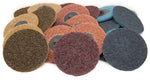
Other specialized disc types include film and paper discs, which are common for sanding projects. Quick change discs, flap discs, and surface conditioning pads are also available for specific, often heavy-duty, different applications where you need to change discs in seconds.
Choosing the Right Grit (Grit Chart)
One of the most important aspects of sanding is grit size. Choose wisely from a variety of grit sizes:
- Coarse Grit (24–60): This is for aggressive tasks like heavy rust removal, taking down high spots on wood, or stripping old layers of paint. It leaves a very noticeable scratch pattern and is not for final finishing.
- Medium Grit (80–120): This grit range is your workhorse. It’s perfect for general-purpose sanding, light surface preparation, and smoothing out surfaces after using a coarser grit.
- Fine Grit (150–220): Use this for final paint prep before applying primer, blending surfaces, and light sanding. It creates a smooth finish with a minimal scratch pattern.
- Finer Grits (240–400+): These are for specialty applications and final finishing work.
Here’s a quick glance:
| Grit Range | Primary Application | Common Abrasive |
| 24 - 40 | Heavy stock removal, paint stripping, and shaping | Ceramic, Zirconia Alumina |
| 60 - 80 | Rough shaping, removing rust, and blending welds | Aluminum Oxide, Zirconia |
| 100 - 150 | General-purpose sanding, preparing surfaces | Aluminum Oxide |
| 180 - 220 | Final sanding before painting the surface | Aluminum Oxide, Silicon Carbide |
| 300 - 400+ | Fine finishing, sanding between coats | Silicon Carbide |
Backings, Coatings, & Materials
The backing and coatings on a disc can be just as important as the grit itself.
Backing Materials
The paper backing is the most common and is flexible for general use. Film backing offers a more uniform, consistent finish and is resistant to tearing. Cloth backing is the most durable, used for aggressive applications and often found on sanding belts and heavy-duty discs.
Coatings
An open coat has abrasive grains spaced farther apart, which helps prevent loading (clogging with dust), making it ideal for soft materials like pine or paint. A closed coat has a dense layer of abrasive grains and is better for hard materials like metal. Many discs also have a stearate coating, which is a dry lubricant that further prevents loading and extends disc life.
Abrasive Materials
The abrasive material determines the disc's performance and durability.
-
Aluminum Oxide Abrasives are the most common and versatile, great for wood and metal.
-
Zirconia alumina works best because it is more flexible than aluminum oxide. Mostly applicable for hardwoods and ferrous metals.
-
Ceramic Abrasives are the toughest and longest-lasting, ideal for aggressive grinding and heavy stock removal on tough materials like stainless steel.
- Silicon Carbide Abrasives are very sharp and brittle, excellent for sanding very hard materials like stone, glass, or clear coats.
Tool Compatibility
Using the right disc with the right tool is non-negotiable for both efficiency and safety.
-
Random Orbital Sander (DA Sander): These tools create a random orbit pattern for a smooth finish without noticeable scratch marks. You must use DA sander discs with a specific sanding pad and hole pattern for proper dust extraction.
-
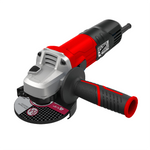
Angle Grinder: These power tools are not for smooth finishes. They are for heavy material removal and cutting. You must use a heavy-duty resin fiber disc or a dedicated grinding disc.
-
Drill Attachments: A simple sanding pad can be attached to a regular drill for small, quick jobs.
- Stationary Disc Sanders and Drum Sanders: These are dedicated woodworking tools that use PSA discs for shaping and dimensioning lumber. They are highly effective but not portable.
Using the correct sanding pad with the right hole pattern is crucial for effective dust extraction, which extends the disc life and improves the quality of your finish.
Common Sanding Errors and Solutions
Even when equipped with the best abrasive tools, mistakes can still slip through the cracks.
Here, we explore some common challenges and offer effective solutions to help you overcome them with confidence.
-
Loading/Clogging: This happens when dust from the workpiece clogs the gaps between the abrasive grains, making the disc useless. It's often caused by using a closed coat disc on a soft material. The fix is to switch to an open coat disc or one with an anti-clog coating.
-
Heat Buildup: Excessive heat can melt the adhesive or a stearate coating on the disc and even burn the workpiece. The fix is to let the tool do the work, use less pressure, and for aggressive tasks, consider ceramic abrasives or even wet sanding with a film-backed disc.
-
Gouging/Uneven Finish: This is typically caused by using a grit that’s too coarse or applying uneven pressure. To fix this, switch to a finer grit and maintain a consistent, slow circular motion across the surface.
- Short Disc Life: If your discs are wearing out too quickly, you're likely using the wrong abrasive material for the job. Selecting the correct sanding disc for the material you are working on will ensure a much longer disc life.
FAQ
Q: What is the best grit for removing paint?
For paint preparation, a coarse grit (40-80) is the right sanding disc. You need to remove the paint, not just scuff it.
Q: Can DA discs run on a drill?
Yes, with the correct backing pad attachment, you can use DA sander discs with a drill for small sanding projects.
Q: Hook & loop vs PSA sanding discs—which lasts longer?
The abrasive grains themselves determine disc life, not the backing type. However, hook and loop sanding discs allow you to change them out, clean them, and reuse them more easily than a PSA sanding disk.
Q: Why do discs clog?
Discs clog when soft material particles, like wood fibers or old paint, get stuck between the abrasive grains. This is a common problem with closed-coat discs on soft materials.
Q: Do hole patterns matter for dust extraction?
Yes, the hole pattern on the disc must align with the holes on your sanding pad for effective dust extraction. Without this alignment, dust will collect, causing the disc to clog and reducing its disc life.
Selecting the Right Abrasive
Choosing the right sanding disc is about more than just grabbing a random pack at the hardware store. It’s about understanding the different types, from PSA sanding discs to hook and loop sanding discs and resin fiber discs, and matching them to your tool and your project.
By using the sanding disc grit chart and selecting the right abrasive and backing material, you can achieve professional results on any of your sanding projects.
For the best abrasive products and a truly wide variety of options, be sure to check out Benchmark Abrasives for the best sanding discs require your next sanding project.
Join Our Newsletter
Sign up to get the latest on sales, new releases and more …Join Our Newsletter
Sign up to get the latest on sales, new releases and more …Shop Categories
Recent Articles
- Resin Fiber Discs vs Flap Discs: When Should You Use Each?
- Best Abrasives for Rust Removal on Steel
- Cut-Off Wheels vs Band Saws: Which is Better for Metal Cutting
- How to Optimize RPM Abrasive Disc Performance & Lifespan
- Surface Conditioning Discs: A Fabricator's Guide
- Best Flap Disc for Stainless Steel: Complete Fabricator’s Guide
- Ceramic vs Zirconia Flap Discs: Which Performs Better for Metal Fabrication
- How to Choose the Right Grit for Metal Sanding Projects
- Tools Collection for Fabrication and Abrasive Workflows
- How to Choose the Right Diamond Blade
Featured Products
-
 746 Reviews
4-1/2" x 7/8" T29 Zirconia High Density Flap Disc - 10 pack
$25.19
-
 738 Reviews
4-1/2" x .040" x 7/8" t1 premium thin cut-off wheel - 25 pack
$20.88
-
 220 Reviews
4-1/2" x 7/8" T27 Zirconia High Density Flap Disc - 10 pack
$25.19
-
 380 Reviews
6" x .045 x 7/8" T1 Premium Thin Cut-Off Wheel - 25 pack
$27.29
-
 55 Reviews
Nonwoven 6" X 9" Scuff, Clean & Finish Hand Pads
$0.83
-
 123 Reviews
4-1/2" x 1/4" x 7/8" T27 Depressed Center Grinding Wheel - 25 pack
$28.34


Blog Categories
- Abrasives
- Sanding
- Grinding Deburring Finishing
- Safety and Cleanliness
- Metal Working
- Selecting Tools And Equipment
- Wood Working
- Art And Design
- Diy Projects
- Industry 4.0
- Buffing
- Cutting Tools
- Carbide Burrs
- PPE
- Wire Brushes
- Bonded Abrasives
- TIG Electrodes
- Wire Wheels
- Bits
- Diamond Blades
- Power Brushes
- Product Reviews
- Grinding
- Finishing
- Industrial Cleaners